COMING HOME
2025
Ryan Carrington
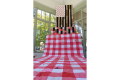
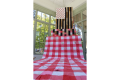
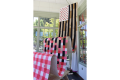
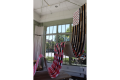
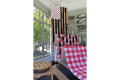
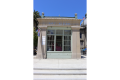
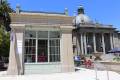
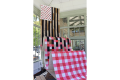
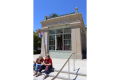
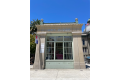
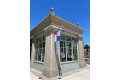
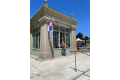
In his Coming Home exhibition at the Redwood City Art Kiosk, Carrington utilizes classic symbols of Americana to explore the ever-shifting definition of the American Dream. His textile work specifically investigates the rich conceptual history that pre- worn garments and iconic patterns, such as gingham, have to share. Through using the uniforms of blue and white collar workers to create American flags, he provides a conduit for empathy between our stratified society by inspiring dialogue across communities of people that represent the far-reaching corners of our culture, history, and socioeconomic status.
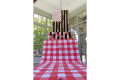
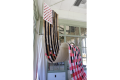
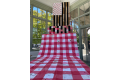
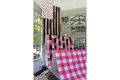
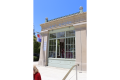
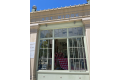
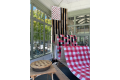
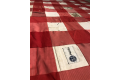
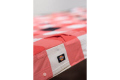
Growing up in the Midwest, Carrington considers the classic gingham plaid tablecloth a quintessential nostalgic part of American culture. For him, the checkerboard red, white, and pink design is associated with the smell of grilling meat, fresh fruits and vegetables, and being together with family. At nearly 30 feet, the immense scale of the work is both a testament to the historical significance of patterns, as well as the work that lies ahead for our country. We are in a moment of reflection and recontextualization of what it means to be an American, and Carrington’s piece brings forth both a reverence for the past, as well as a call for a renewed faith in a future American identity.
In his Coming Home exhibition at the Redwood City Art Kiosk, Carrington utilizes classic symbols of Americana to explore the ever-shifting definition of the American Dream. His textile work specifically investigates the rich conceptual history that pre- worn garments and iconic patterns, such as gingham, have to share. Through using the uniforms of blue and white collar workers to create American flags, he provides a conduit for empathy between our stratified society by inspiring dialogue across communities of people that represent the far-reaching corners of our culture, history, and socioeconomic status.
Growing up in the Midwest, Carrington considers the classic gingham plaid tablecloth a quintessential nostalgic part of American culture. For him, the checkerboard red, white, and pink design is associated with the smell of grilling meat, fresh fruits and vegetables, and being together with family. At nearly 30 feet, the immense scale of the work is both a testament to the historical significance of patterns, as well as the work that lies ahead for our country. We are in a moment of reflection and recontextualization of what it means to be an American, and Carrington’s piece brings forth both a reverence for the past, as well as a call for a renewed faith in a future American identity.
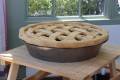
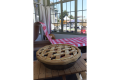
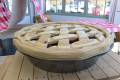
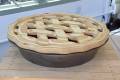
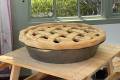
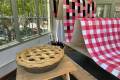
Carrington further utilizes familiar symbols of American barbeque culture in his piece titled after his grandmother, Grandma Mae. Created with a plywood crust and necktie filling, this representation of an iconic American dessert brings together both blue and white collar materials in a hopeful mix from different socio economic statuses. Additionally, the larger-than life shift in scale raises the level of importance of these future hypothetical conversations and collaborations.
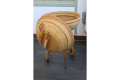
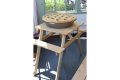
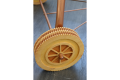
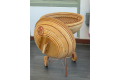
The final element entitled Larry, after his father, highlights Carrington’s upbringing in a hardworking family in Wisconsin by utilizing exceptional precision and craftsmanship with the everyday materials of plywood and plumbing parts. It’s an homage to simpler times and the power of a grill to gather friends and family together, while also inviting the viewer into the fold to share their experience.
COMING HOME
2025
Ryan Carrington
In his Coming Home exhibition at the Redwood City Art Kiosk, Carrington utilizes classic symbols of Americana to explore the ever-shifting definition of the American Dream. His textile work specifically investigates the rich conceptual history that pre- worn garments and iconic patterns, such as gingham, have to share. Through using the uniforms of blue and white collar workers to create American flags, he provides a conduit for empathy between our stratified society by inspiring dialogue across communities of people that represent the far-reaching corners of our culture, history, and socioeconomic status.
Growing up in the Midwest, Carrington considers the classic gingham plaid tablecloth a quintessential nostalgic part of American culture. For him, the checkerboard red, white, and pink design is associated with the smell of grilling meat, fresh fruits and vegetables, and being together with family. At nearly 30 feet, the immense scale of the work is both a testament to the historical significance of patterns, as well as the work that lies ahead for our country. We are in a moment of reflection and recontextualization of what it means to be an American, and Carrington’s piece brings forth both a reverence for the past, as well as a call for a renewed faith in a future American identity.
In his Coming Home exhibition at the Redwood City Art Kiosk, Carrington utilizes classic symbols of Americana to explore the ever-shifting definition of the American Dream. His textile work specifically investigates the rich conceptual history that pre- worn garments and iconic patterns, such as gingham, have to share. Through using the uniforms of blue and white collar workers to create American flags, he provides a conduit for empathy between our stratified society by inspiring dialogue across communities of people that represent the far-reaching corners of our culture, history, and socioeconomic status.
Growing up in the Midwest, Carrington considers the classic gingham plaid tablecloth a quintessential nostalgic part of American culture. For him, the checkerboard red, white, and pink design is associated with the smell of grilling meat, fresh fruits and vegetables, and being together with family. At nearly 30 feet, the immense scale of the work is both a testament to the historical significance of patterns, as well as the work that lies ahead for our country. We are in a moment of reflection and recontextualization of what it means to be an American, and Carrington’s piece brings forth both a reverence for the past, as well as a call for a renewed faith in a future American identity.
Carrington further utilizes familiar symbols of American barbeque culture in his piece titled after his grandmother, Grandma Mae. Created with a plywood crust and necktie filling, this representation of an iconic American dessert brings together both blue and white collar materials in a hopeful mix from different socio economic statuses. Additionally, the larger-than life shift in scale raises the level of importance of these future hypothetical conversations and collaborations.
The final element entitled Larry, after his father, highlights Carrington’s upbringing in a hardworking family in Wisconsin by utilizing exceptional precision and craftsmanship with the everyday materials of plywood and plumbing parts. It’s an homage to simpler times and the power of a grill to gather friends and family together, while also inviting the viewer into the fold to share their experience.
COMING HOME
2025
Ryan Carrington
In his Coming Home exhibition at the Redwood City Art Kiosk, Carrington utilizes classic symbols of Americana to explore the ever-shifting definition of the American Dream. His textile work specifically investigates the rich conceptual history that pre- worn garments and iconic patterns, such as gingham, have to share. Through using the uniforms of blue and white collar workers to create American flags, he provides a conduit for empathy between our stratified society by inspiring dialogue across communities of people that represent the far-reaching corners of our culture, history, and socioeconomic status.
Growing up in the Midwest, Carrington considers the classic gingham plaid tablecloth a quintessential nostalgic part of American culture. For him, the checkerboard red, white, and pink design is associated with the smell of grilling meat, fresh fruits and vegetables, and being together with family. At nearly 30 feet, the immense scale of the work is both a testament to the historical significance of patterns, as well as the work that lies ahead for our country. We are in a moment of reflection and recontextualization of what it means to be an American, and Carrington’s piece brings forth both a reverence for the past, as well as a call for a renewed faith in a future American identity.
In his Coming Home exhibition at the Redwood City Art Kiosk, Carrington utilizes classic symbols of Americana to explore the ever-shifting definition of the American Dream. His textile work specifically investigates the rich conceptual history that pre- worn garments and iconic patterns, such as gingham, have to share. Through using the uniforms of blue and white collar workers to create American flags, he provides a conduit for empathy between our stratified society by inspiring dialogue across communities of people that represent the far-reaching corners of our culture, history, and socioeconomic status.
Growing up in the Midwest, Carrington considers the classic gingham plaid tablecloth a quintessential nostalgic part of American culture. For him, the checkerboard red, white, and pink design is associated with the smell of grilling meat, fresh fruits and vegetables, and being together with family. At nearly 30 feet, the immense scale of the work is both a testament to the historical significance of patterns, as well as the work that lies ahead for our country. We are in a moment of reflection and recontextualization of what it means to be an American, and Carrington’s piece brings forth both a reverence for the past, as well as a call for a renewed faith in a future American identity.
Carrington further utilizes familiar symbols of American barbeque culture in his piece titled after his grandmother, Grandma Mae. Created with a plywood crust and necktie filling, this representation of an iconic American dessert brings together both blue and white collar materials in a hopeful mix from different socio economic statuses. Additionally, the larger-than life shift in scale raises the level of importance of these future hypothetical conversations and collaborations.
The final element entitled Larry, after his father, highlights Carrington’s upbringing in a hardworking family in Wisconsin by utilizing exceptional precision and craftsmanship with the everyday materials of plywood and plumbing parts. It’s an homage to simpler times and the power of a grill to gather friends and family together, while also inviting the viewer into the fold to share their experience.
COMING HOME
2025
Ryan Carrington
In his Coming Home exhibition at the Redwood City Art Kiosk, Carrington utilizes classic symbols of Americana to explore the ever-shifting definition of the American Dream. His textile work specifically investigates the rich conceptual history that pre- worn garments and iconic patterns, such as gingham, have to share. Through using the uniforms of blue and white collar workers to create American flags, he provides a conduit for empathy between our stratified society by inspiring dialogue across communities of people that represent the far-reaching corners of our culture, history, and socioeconomic status.
Growing up in the Midwest, Carrington considers the classic gingham plaid tablecloth a quintessential nostalgic part of American culture. For him, the checkerboard red, white, and pink design is associated with the smell of grilling meat, fresh fruits and vegetables, and being together with family. At nearly 30 feet, the immense scale of the work is both a testament to the historical significance of patterns, as well as the work that lies ahead for our country. We are in a moment of reflection and recontextualization of what it means to be an American, and Carrington’s piece brings forth both a reverence for the past, as well as a call for a renewed faith in a future American identity.
In his Coming Home exhibition at the Redwood City Art Kiosk, Carrington utilizes classic symbols of Americana to explore the ever-shifting definition of the American Dream. His textile work specifically investigates the rich conceptual history that pre- worn garments and iconic patterns, such as gingham, have to share. Through using the uniforms of blue and white collar workers to create American flags, he provides a conduit for empathy between our stratified society by inspiring dialogue across communities of people that represent the far-reaching corners of our culture, history, and socioeconomic status.
Growing up in the Midwest, Carrington considers the classic gingham plaid tablecloth a quintessential nostalgic part of American culture. For him, the checkerboard red, white, and pink design is associated with the smell of grilling meat, fresh fruits and vegetables, and being together with family. At nearly 30 feet, the immense scale of the work is both a testament to the historical significance of patterns, as well as the work that lies ahead for our country. We are in a moment of reflection and recontextualization of what it means to be an American, and Carrington’s piece brings forth both a reverence for the past, as well as a call for a renewed faith in a future American identity.
Carrington further utilizes familiar symbols of American barbeque culture in his piece titled after his grandmother, Grandma Mae. Created with a plywood crust and necktie filling, this representation of an iconic American dessert brings together both blue and white collar materials in a hopeful mix from different socio economic statuses. Additionally, the larger-than life shift in scale raises the level of importance of these future hypothetical conversations and collaborations.
The final element entitled Larry, after his father, highlights Carrington’s upbringing in a hardworking family in Wisconsin by utilizing exceptional precision and craftsmanship with the everyday materials of plywood and plumbing parts. It’s an homage to simpler times and the power of a grill to gather friends and family together, while also inviting the viewer into the fold to share their experience.
ARTWORK
ARTWORK
ARTWORK