UNDERSTORY
2026
Erika Knerr
In her new installation, Understory, Erika Knerr transforms the Art Kiosk in Redwood City into a suspended, layered rainforest environment that draws on her early mural work for the Tropical Zone of New York’s Central Park Zoo in the 1980s. Reengaging imagery first created for the zoo’s 1988 renovation—which reframed the institution around research, conservation, education, and wildlife advocacy—Knerr revisits the illusion of tropical abundance once painted inside a constructed rainforest in the middle of the city.
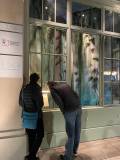
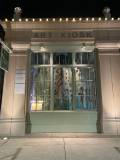
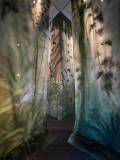
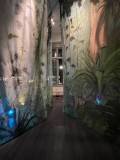
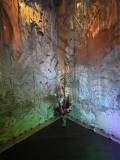
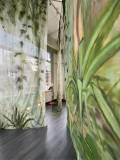
The Art Kiosk, an enclosed glass space, reads like a greenhouse or a display enclosure depicting a natural habitat. Here Knerr translates those original tropical murals onto muslin and sheer fabric. The installation is composed of airbrushed translucent panels, overlapping silhouettes, and fragments of foliage that hang in layers, creating a rainforest that can only be approached from the outside. The installation is visible only through the Kiosk’s windows, positioning the public once again at the glass, looking into a carefully painted ecosystem that never grants full entry.
In her new installation, Understory, Erika Knerr transforms the Art Kiosk in Redwood City into a suspended, layered rainforest environment that draws on her early mural work for the Tropical Zone of New York’s Central Park Zoo in the 1980s. Reengaging imagery first created for the zoo’s 1988 renovation—which reframed the institution around research, conservation, education, and wildlife advocacy—Knerr revisits the illusion of tropical abundance once painted inside a constructed rainforest in the middle of the city.
The Art Kiosk, an enclosed glass space, reads like a greenhouse or a display enclosure depicting a natural habitat. Here Knerr translates those original tropical murals onto muslin and sheer fabric. The installation is composed of airbrushed translucent panels, overlapping silhouettes, and fragments of foliage that hang in layers, creating a rainforest that can only be approached from the outside. The installation is visible only through the Kiosk’s windows, positioning the public once again at the glass, looking into a carefully painted ecosystem that never grants full entry.
Knerr’s painting process infuses the installation with a ghostly, veil-like atmosphere that shifts between day and night. Working on absorbent, earthy muslin, she builds up an underpainting using large batches of coffee ink. This is coffee made into ink with a simple recipe and was collected in collaboration with a local independent grocery store that donated its end-of-day coffee, connecting the work to cycles of consumption and sustainability. Over this coffee-stained ground, she airbrushes the rainforest murals, echoing the trompe l’oeil techniques she employed decades earlier with a paint sprayer in the Central Park Zoo’s Tropical Zone.
Originally conceived as backdrops for captive understory creatures, murals were part of a larger immersive illusion that shaped how viewers understood animals, climate, and environment. In Understory, this history is brought forward and critically reframed. By echoing the zoo’s logic of containment—where both animals and imagery are displayed for human viewing—the installation raises questions about captivity, visibility, and who controls the frame. It invites viewers to see their own reflections layered over the transplanted rainforest and to consider what might be learned from nonhuman life and from pre-anthropocentric rainforests that exist with or without us in a biodiverse interdependence.
Understory positions the Art Kiosk as both a site of looking and a metaphorical enclosure, asking visitors to pause at the threshold and confront the uneasy boundaries between spectacle, care, and control in our relationships with the more-than-human world.
UNDERSTORY
2026
Erika Knerr
In her new installation, Understory, Erika Knerr transforms the Art Kiosk in Redwood City into a suspended, layered rainforest environment that draws on her early mural work for the Tropical Zone of New York’s Central Park Zoo in the 1980s. Reengaging imagery first created for the zoo’s 1988 renovation—which reframed the institution around research, conservation, education, and wildlife advocacy—Knerr revisits the illusion of tropical abundance once painted inside a constructed rainforest in the middle of the city.
The Art Kiosk, an enclosed glass space, reads like a greenhouse or a display enclosure depicting a natural habitat. Here Knerr translates those original tropical murals onto muslin and sheer fabric. The installation is composed of airbrushed translucent panels, overlapping silhouettes, and fragments of foliage that hang in layers, creating a rainforest that can only be approached from the outside. The installation is visible only through the Kiosk’s windows, positioning the public once again at the glass, looking into a carefully painted ecosystem that never grants full entry.
In her new installation, Understory, Erika Knerr transforms the Art Kiosk in Redwood City into a suspended, layered rainforest environment that draws on her early mural work for the Tropical Zone of New York’s Central Park Zoo in the 1980s. Reengaging imagery first created for the zoo’s 1988 renovation—which reframed the institution around research, conservation, education, and wildlife advocacy—Knerr revisits the illusion of tropical abundance once painted inside a constructed rainforest in the middle of the city.
The Art Kiosk, an enclosed glass space, reads like a greenhouse or a display enclosure depicting a natural habitat. Here Knerr translates those original tropical murals onto muslin and sheer fabric. The installation is composed of airbrushed translucent panels, overlapping silhouettes, and fragments of foliage that hang in layers, creating a rainforest that can only be approached from the outside. The installation is visible only through the Kiosk’s windows, positioning the public once again at the glass, looking into a carefully painted ecosystem that never grants full entry.
Knerr’s painting process infuses the installation with a ghostly, veil-like atmosphere that shifts between day and night. Working on absorbent, earthy muslin, she builds up an underpainting using large batches of coffee ink. This is coffee made into ink with a simple recipe and was collected in collaboration with a local independent grocery store that donated its end-of-day coffee, connecting the work to cycles of consumption and sustainability. Over this coffee-stained ground, she airbrushes the rainforest murals, echoing the trompe l’oeil techniques she employed decades earlier with a paint sprayer in the Central Park Zoo’s Tropical Zone.
Originally conceived as backdrops for captive understory creatures, murals were part of a larger immersive illusion that shaped how viewers understood animals, climate, and environment. In Understory, this history is brought forward and critically reframed. By echoing the zoo’s logic of containment—where both animals and imagery are displayed for human viewing—the installation raises questions about captivity, visibility, and who controls the frame. It invites viewers to see their own reflections layered over the transplanted rainforest and to consider what might be learned from nonhuman life and from pre-anthropocentric rainforests that exist with or without us in a biodiverse interdependence.
Understory positions the Art Kiosk as both a site of looking and a metaphorical enclosure, asking visitors to pause at the threshold and confront the uneasy boundaries between spectacle, care, and control in our relationships with the more-than-human world.
UNDERSTORY
2026
Erika Knerr
In her new installation, Understory, Erika Knerr transforms the Art Kiosk in Redwood City into a suspended, layered rainforest environment that draws on her early mural work for the Tropical Zone of New York’s Central Park Zoo in the 1980s. Reengaging imagery first created for the zoo’s 1988 renovation—which reframed the institution around research, conservation, education, and wildlife advocacy—Knerr revisits the illusion of tropical abundance once painted inside a constructed rainforest in the middle of the city.
The Art Kiosk, an enclosed glass space, reads like a greenhouse or a display enclosure depicting a natural habitat. Here Knerr translates those original tropical murals onto muslin and sheer fabric. The installation is composed of airbrushed translucent panels, overlapping silhouettes, and fragments of foliage that hang in layers, creating a rainforest that can only be approached from the outside. The installation is visible only through the Kiosk’s windows, positioning the public once again at the glass, looking into a carefully painted ecosystem that never grants full entry.
In her new installation, Understory, Erika Knerr transforms the Art Kiosk in Redwood City into a suspended, layered rainforest environment that draws on her early mural work for the Tropical Zone of New York’s Central Park Zoo in the 1980s. Reengaging imagery first created for the zoo’s 1988 renovation—which reframed the institution around research, conservation, education, and wildlife advocacy—Knerr revisits the illusion of tropical abundance once painted inside a constructed rainforest in the middle of the city.
The Art Kiosk, an enclosed glass space, reads like a greenhouse or a display enclosure depicting a natural habitat. Here Knerr translates those original tropical murals onto muslin and sheer fabric. The installation is composed of airbrushed translucent panels, overlapping silhouettes, and fragments of foliage that hang in layers, creating a rainforest that can only be approached from the outside. The installation is visible only through the Kiosk’s windows, positioning the public once again at the glass, looking into a carefully painted ecosystem that never grants full entry.
Knerr’s painting process infuses the installation with a ghostly, veil-like atmosphere that shifts between day and night. Working on absorbent, earthy muslin, she builds up an underpainting using large batches of coffee ink. This is coffee made into ink with a simple recipe and was collected in collaboration with a local independent grocery store that donated its end-of-day coffee, connecting the work to cycles of consumption and sustainability. Over this coffee-stained ground, she airbrushes the rainforest murals, echoing the trompe l’oeil techniques she employed decades earlier with a paint sprayer in the Central Park Zoo’s Tropical Zone.
Originally conceived as backdrops for captive understory creatures, murals were part of a larger immersive illusion that shaped how viewers understood animals, climate, and environment. In Understory, this history is brought forward and critically reframed. By echoing the zoo’s logic of containment—where both animals and imagery are displayed for human viewing—the installation raises questions about captivity, visibility, and who controls the frame. It invites viewers to see their own reflections layered over the transplanted rainforest and to consider what might be learned from nonhuman life and from pre-anthropocentric rainforests that exist with or without us in a biodiverse interdependence.
Understory positions the Art Kiosk as both a site of looking and a metaphorical enclosure, asking visitors to pause at the threshold and confront the uneasy boundaries between spectacle, care, and control in our relationships with the more-than-human world.
UNDERSTORY
2026
Erika Knerr
In her new installation, Understory, Erika Knerr transforms the Art Kiosk in Redwood City into a suspended, layered rainforest environment that draws on her early mural work for the Tropical Zone of New York’s Central Park Zoo in the 1980s. Reengaging imagery first created for the zoo’s 1988 renovation—which reframed the institution around research, conservation, education, and wildlife advocacy—Knerr revisits the illusion of tropical abundance once painted inside a constructed rainforest in the middle of the city.
The Art Kiosk, an enclosed glass space, reads like a greenhouse or a display enclosure depicting a natural habitat. Here Knerr translates those original tropical murals onto muslin and sheer fabric. The installation is composed of airbrushed translucent panels, overlapping silhouettes, and fragments of foliage that hang in layers, creating a rainforest that can only be approached from the outside. The installation is visible only through the Kiosk’s windows, positioning the public once again at the glass, looking into a carefully painted ecosystem that never grants full entry.
In her new installation, Understory, Erika Knerr transforms the Art Kiosk in Redwood City into a suspended, layered rainforest environment that draws on her early mural work for the Tropical Zone of New York’s Central Park Zoo in the 1980s. Reengaging imagery first created for the zoo’s 1988 renovation—which reframed the institution around research, conservation, education, and wildlife advocacy—Knerr revisits the illusion of tropical abundance once painted inside a constructed rainforest in the middle of the city.
The Art Kiosk, an enclosed glass space, reads like a greenhouse or a display enclosure depicting a natural habitat. Here Knerr translates those original tropical murals onto muslin and sheer fabric. The installation is composed of airbrushed translucent panels, overlapping silhouettes, and fragments of foliage that hang in layers, creating a rainforest that can only be approached from the outside. The installation is visible only through the Kiosk’s windows, positioning the public once again at the glass, looking into a carefully painted ecosystem that never grants full entry.
Knerr’s painting process infuses the installation with a ghostly, veil-like atmosphere that shifts between day and night. Working on absorbent, earthy muslin, she builds up an underpainting using large batches of coffee ink. This is coffee made into ink with a simple recipe and was collected in collaboration with a local independent grocery store that donated its end-of-day coffee, connecting the work to cycles of consumption and sustainability. Over this coffee-stained ground, she airbrushes the rainforest murals, echoing the trompe l’oeil techniques she employed decades earlier with a paint sprayer in the Central Park Zoo’s Tropical Zone.
Originally conceived as backdrops for captive understory creatures, murals were part of a larger immersive illusion that shaped how viewers understood animals, climate, and environment. In Understory, this history is brought forward and critically reframed. By echoing the zoo’s logic of containment—where both animals and imagery are displayed for human viewing—the installation raises questions about captivity, visibility, and who controls the frame. It invites viewers to see their own reflections layered over the transplanted rainforest and to consider what might be learned from nonhuman life and from pre-anthropocentric rainforests that exist with or without us in a biodiverse interdependence.
Understory positions the Art Kiosk as both a site of looking and a metaphorical enclosure, asking visitors to pause at the threshold and confront the uneasy boundaries between spectacle, care, and control in our relationships with the more-than-human world.
ARTWORK
ARTWORK
ARTWORK