NORMAN FOSTER
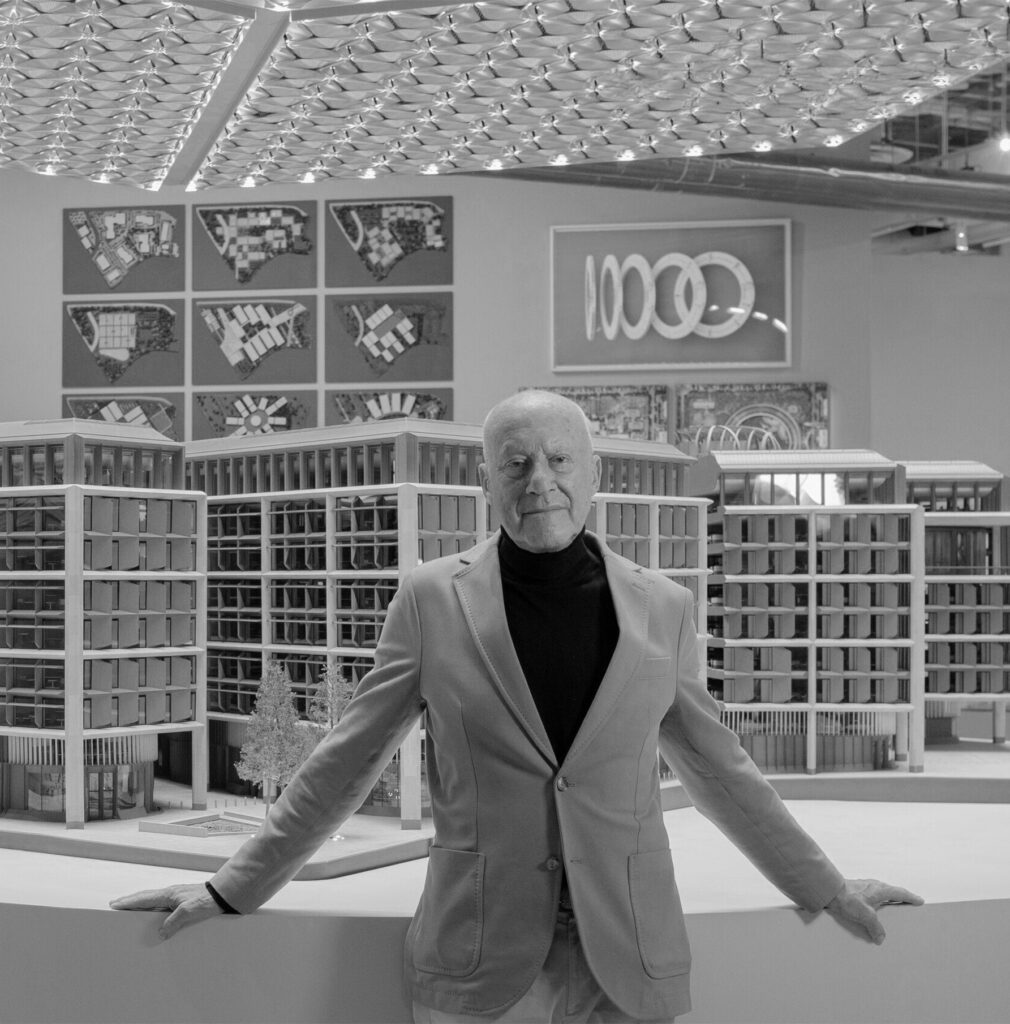
Norman Foster (born 1935) is a prolific British architect and a leading figure in the high-tech architecture movement. Raised in a working-class family in Manchester, he studied architecture at the University of Manchester before earning a master’s degree from Yale University on a fellowship. In 1967, he founded Foster + Partners, a global practice that became renowned for its integration of advanced technology, industrial materials, and glass-and-steel aesthetics. Foster’s early work, such as the Willis Building in Ipswich, challenged traditional office design, while his groundbreaking HSBC Building in Hong Kong established his reputation for "inside-out" structures that prioritize flexible, open floor plans and visible engineering.
Throughout his six-decade career, Foster has been a pioneer in sustainable design and urban infrastructure. His portfolio includes some of the world's most recognizable landmarks, such as the 30 St Mary Axe (commonly known as "The Gherkin") in London, the restoration of the Reichstag in Berlin, and the Millau Viaduct in France. His firm is also responsible for massive infrastructure projects, including the Beijing Capital International Airport and Apple Park in Cupertino. Foster’s work is characterized by a commitment to efficiency and "doing more with less," often utilizing computer-aided design to create complex geometric forms that maximize natural light and airflow.
Foster has received nearly every major honor in the field of architecture, including...
Norman Foster (born 1935) is a prolific British architect and a leading figure in the high-tech architecture movement. Raised in a working-class family in Manchester, he studied architecture at the University of Manchester before earning a master’s degree from Yale University on a fellowship. In 1967, he founded Foster + Partners, a global practice that became renowned for its integration of advanced technology, industrial materials, and glass-and-steel aesthetics. Foster’s early work, such as the Willis Building in Ipswich, challenged traditional office design, while his groundbreaking HSBC Building in Hong Kong established his reputation for "inside-out" structures that prioritize flexible, open floor plans and visible engineering.
Throughout his six-decade career, Foster has been a pioneer in sustainable design and urban infrastructure. His portfolio includes some of the world's most recognizable landmarks, such as the 30 St Mary Axe (commonly known as "The Gherkin") in London, the restoration of the Reichstag in Berlin, and the Millau Viaduct in France. His firm is also responsible for massive infrastructure projects, including the Beijing Capital International Airport and Apple Park in Cupertino. Foster’s work is characterized by a commitment to efficiency and "doing more with less," often utilizing computer-aided design to create complex geometric forms that maximize natural light and airflow.
Foster has received nearly every major honor in the field of architecture, including the Pritzker Architecture Prize in 1999 and the Stirling Prize on multiple occasions. He was knighted in 1990 and later appointed to the Order of Merit and made a life peer as Baron Foster of Thames Bank. Beyond individual buildings, his influence extends to urban planning and the future of mobility, with his firm exploring concepts for lunar habitations and sustainable "Masdar City" in Abu Dhabi. Today, he remains one of the most influential architects of the modern era, consistently pushing the boundaries of how technology can enhance the human experience within the built environment.
NORMAN FOSTER
Norman Foster (born 1935) is a prolific British architect and a leading figure in the high-tech architecture movement. Raised in a working-class family in Manchester, he studied architecture at the University of Manchester before earning a master’s...
Norman Foster (born 1935) is a prolific British architect and a leading figure in the high-tech architecture movement. Raised in a working-class family in Manchester, he studied architecture at the University of Manchester before earning a master’s degree from Yale University on a fellowship. In 1967, he founded Foster + Partners, a global practice that became renowned for its integration of advanced technology, industrial materials, and glass-and-steel aesthetics. Foster’s early work, such as the Willis Building in Ipswich, challenged traditional office design, while his groundbreaking HSBC Building in Hong Kong established his reputation for "inside-out" structures that prioritize flexible, open floor plans and visible engineering.
Throughout his six-decade career, Foster has been a pioneer in sustainable design and urban infrastructure. His portfolio includes some of the world's most recognizable landmarks, such as the 30 St Mary Axe (commonly known as "The Gherkin") in London, the restoration of the Reichstag in Berlin, and the Millau Viaduct in France. His firm is also responsible for massive infrastructure projects, including the Beijing Capital International Airport and Apple Park in Cupertino. Foster’s work is characterized by a commitment to efficiency and "doing more with less," often utilizing computer-aided design to create complex geometric forms that maximize natural light and airflow.
Foster has received nearly every major honor in the field of architecture, including the Pritzker Architecture Prize in 1999 and the Stirling Prize on multiple occasions. He was knighted in 1990 and later appointed to the Order of Merit and made a life peer as Baron Foster of Thames Bank. Beyond individual buildings, his influence extends to urban planning and the future of mobility, with his firm exploring concepts for lunar habitations and sustainable "Masdar City" in Abu Dhabi. Today, he remains one of the most influential architects of the modern era, consistently pushing the boundaries of how technology can enhance the human experience within the built environment.
NORMAN FOSTER
Norman Foster (born 1935) is a prolific British architect and a leading figure in the high-tech architecture movement. Raised in a working-class family in Manchester, he studied architecture at the University of Manchester before earning a master’s degree from Yale University on a fellowship. In 1967, he founded Foster + Partners, a global practice that became renowned for its integration of advanced technology, industrial materials, and glass-and-steel aesthetics. Foster’s early work, such as the Willis Building in Ipswich, challenged traditional office design, while his groundbreaking HSBC Building in Hong Kong established his reputation for “inside-out” structures that prioritize flexible, open floor plans and visible engineering.
Throughout his six-decade career, Foster has been a pioneer in sustainable design and urban infrastructure. His portfolio includes some of the world’s most recognizable landmarks, such as the 30 St Mary Axe (commonly known as “The Gherkin”) in London, the restoration of the Reichstag in Berlin, and the Millau Viaduct in France. His firm is also responsible for massive infrastructure projects, including the Beijing Capital International Airport and Apple Park in Cupertino. Foster’s work is characterized by a commitment to efficiency and “doing more with less,” often utilizing computer-aided design to create complex geometric forms that maximize natural light and airflow.
Foster has received nearly every major honor in the field of architecture, including the Pritzker Architecture Prize in 1999 and the Stirling Prize on multiple occasions. He was knighted in 1990 and later appointed to the Order of Merit and made a life peer as Baron Foster of Thames Bank. Beyond individual buildings, his influence extends to urban planning and the future of mobility, with his firm exploring concepts for lunar habitations and sustainable “Masdar City” in Abu Dhabi. Today, he remains one of the most influential architects of the modern era, consistently pushing the boundaries of how technology can enhance the human experience within the built environment.
ARTWORK
ARTWORK
ARTWORK