PETER HUTCHINSON
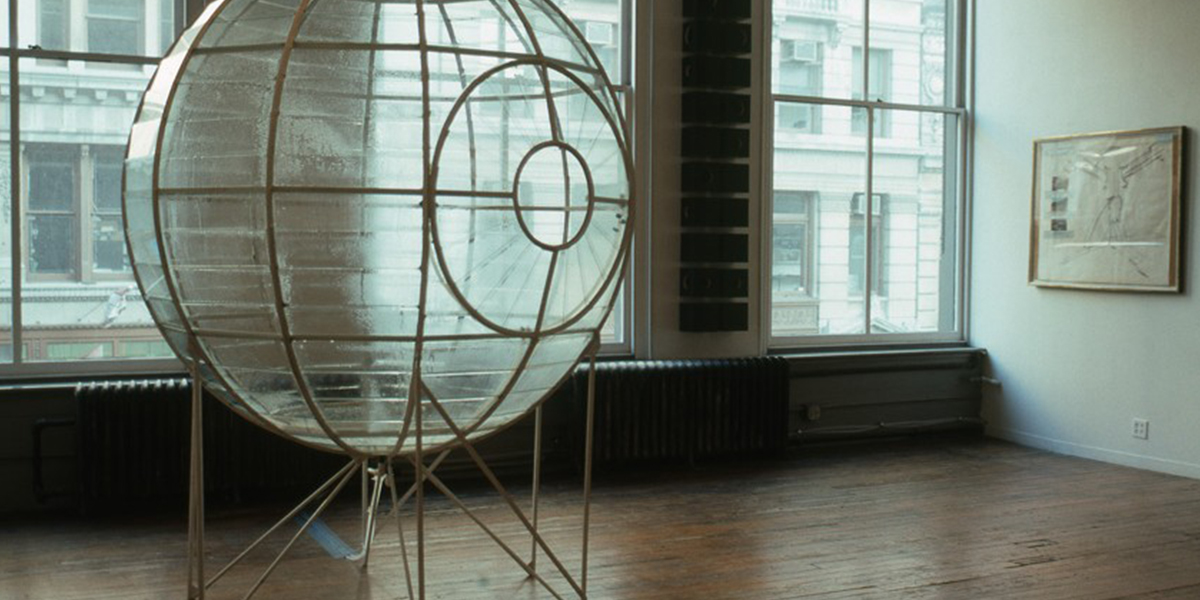
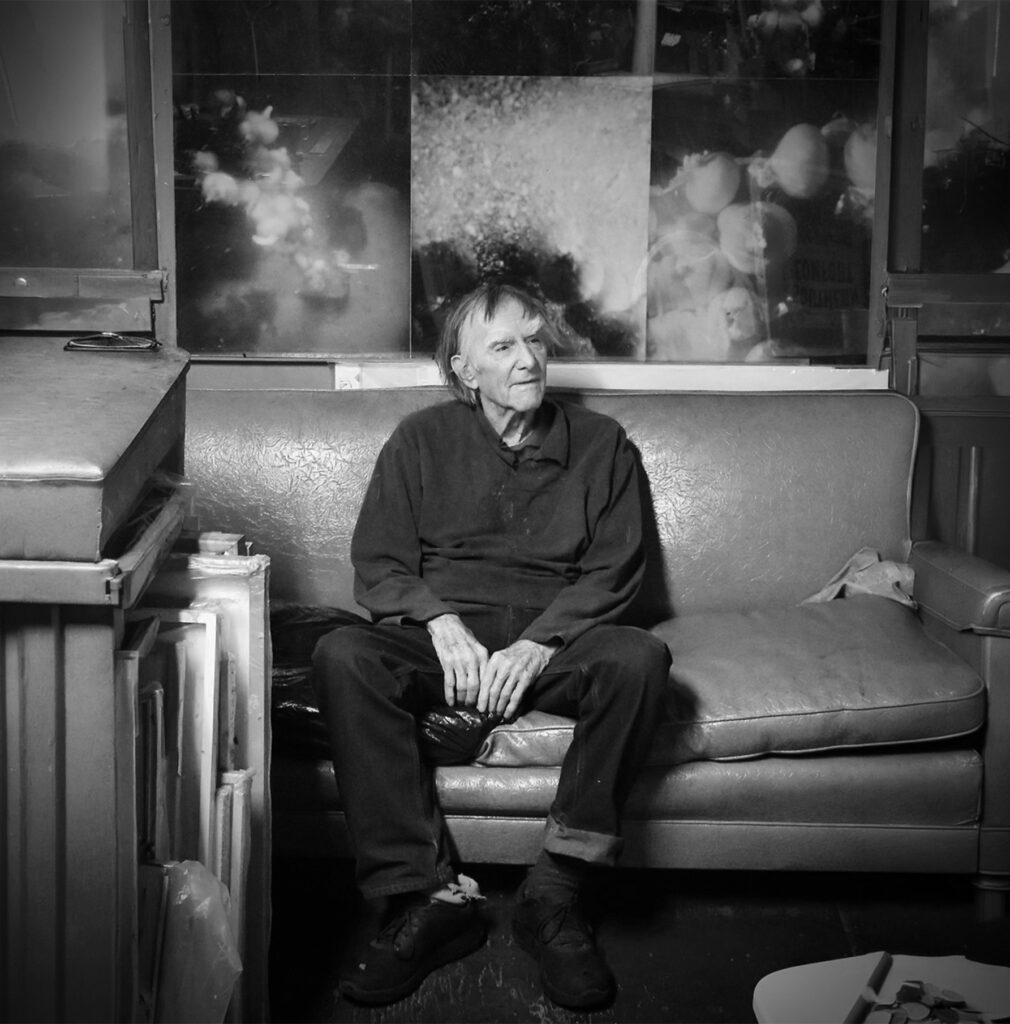
Peter Hutchinson (born 1930) is a British-born American artist recognized as a pioneer of the Land Art and Narrative Art movements. After moving to the United States in the early 1950s, he earned his BFA from the University of Illinois and eventually settled in Provincetown, Massachusetts. His work is characterized by a deep fascination with nature, ecology, and the intersection of human thought and the organic world. Unlike some of his contemporaries who created massive, earth-moving interventions, Hutchinson’s practice is often ephemeral and intimate, utilizing photography, text, and found organic materials to document temporary actions performed in the landscape.
In the late 1960s, Hutchinson gained international attention for projects that combined biological processes with artistic concepts, such as his Apple Triangle (1969), created on the seafloor of Tobago, and his Threaded Calabash series. A key element of his mature style is the use of the "photo-text" format, where he pairs vibrant color photographs of landscapes—often arranged in collage-like grids or "thrown" perspectives—with handwritten anecdotes, musings, or scientific observations. This approach allows him to explore the subjectivity of memory and the passage of time, framing the natural world not just as a physical site but as a psychological space.
Peter Hutchinson (born 1930) is a British-born American artist recognized as a pioneer of the Land Art and Narrative Art movements. After moving to the United States in the early 1950s, he earned his BFA from the University of Illinois and eventually settled in Provincetown, Massachusetts. His work is characterized by a deep fascination with nature, ecology, and the intersection of human thought and the organic world. Unlike some of his contemporaries who created massive, earth-moving interventions, Hutchinson’s practice is often ephemeral and intimate, utilizing photography, text, and found organic materials to document temporary actions performed in the landscape.
In the late 1960s, Hutchinson gained international attention for projects that combined biological processes with artistic concepts, such as his Apple Triangle (1969), created on the seafloor of Tobago, and his Threaded Calabash series. A key element of his mature style is the use of the "photo-text" format, where he pairs vibrant color photographs of landscapes—often arranged in collage-like grids or "thrown" perspectives—with handwritten anecdotes, musings, or scientific observations. This approach allows him to explore the subjectivity of memory and the passage of time, framing the natural world not just as a physical site but as a psychological space.
Throughout a career spanning over six decades, Hutchinson has been the subject of numerous solo exhibitions and retrospectives, including at the Kunstmuseum Basel and the Arp Museum in Germany. His work is held in the permanent collections of the Museum of Modern Art (MoMA) in New York, the Centre Pompidou in Paris, and the Tate in London. By merging the conceptual rigor of Land Art with a personal, storytelling sensibility, Hutchinson has remained a vital figure in contemporary art, continuously investigating how language and vision shape our understanding of the environment.
PETER HUTCHINSON
Peter Hutchinson (born 1930) is a British-born American artist recognized as a pioneer of the Land Art and Narrative Art movements. After moving to the United States in the early 1950s, he earned his BFA from the University of Illinois and...
Peter Hutchinson (born 1930) is a British-born American artist recognized as a pioneer of the Land Art and Narrative Art movements. After moving to the United States in the early 1950s, he earned his BFA from the University of Illinois and eventually settled in Provincetown, Massachusetts. His work is characterized by a deep fascination with nature, ecology, and the intersection of human thought and the organic world. Unlike some of his contemporaries who created massive, earth-moving interventions, Hutchinson’s practice is often ephemeral and intimate, utilizing photography, text, and found organic materials to document temporary actions performed in the landscape.
In the late 1960s, Hutchinson gained international attention for projects that combined biological processes with artistic concepts, such as his Apple Triangle (1969), created on the seafloor of Tobago, and his Threaded Calabash series. A key element of his mature style is the use of the "photo-text" format, where he pairs vibrant color photographs of landscapes—often arranged in collage-like grids or "thrown" perspectives—with handwritten anecdotes, musings, or scientific observations. This approach allows him to explore the subjectivity of memory and the passage of time, framing the natural world not just as a physical site but as a psychological space.
Throughout a career spanning over six decades, Hutchinson has been the subject of numerous solo exhibitions and retrospectives, including at the Kunstmuseum Basel and the Arp Museum in Germany. His work is held in the permanent collections of the Museum of Modern Art (MoMA) in New York, the Centre Pompidou in Paris, and the Tate in London. By merging the conceptual rigor of Land Art with a personal, storytelling sensibility, Hutchinson has remained a vital figure in contemporary art, continuously investigating how language and vision shape our understanding of the environment.
PETER HUTCHINSON
Peter Hutchinson (born 1930) is a British-born American artist recognized as a pioneer of the Land Art and Narrative Art movements. After moving to the United States in the early 1950s, he earned his BFA from the University of Illinois and eventually settled in Provincetown, Massachusetts. His work is characterized by a deep fascination with nature, ecology, and the intersection of human thought and the organic world. Unlike some of his contemporaries who created massive, earth-moving interventions, Hutchinson’s practice is often ephemeral and intimate, utilizing photography, text, and found organic materials to document temporary actions performed in the landscape.
In the late 1960s, Hutchinson gained international attention for projects that combined biological processes with artistic concepts, such as his Apple Triangle (1969), created on the seafloor of Tobago, and his Threaded Calabash series. A key element of his mature style is the use of the “photo-text” format, where he pairs vibrant color photographs of landscapes—often arranged in collage-like grids or “thrown” perspectives—with handwritten anecdotes, musings, or scientific observations. This approach allows him to explore the subjectivity of memory and the passage of time, framing the natural world not just as a physical site but as a psychological space.
Throughout a career spanning over six decades, Hutchinson has been the subject of numerous solo exhibitions and retrospectives, including at the Kunstmuseum Basel and the Arp Museum in Germany. His work is held in the permanent collections of the Museum of Modern Art (MoMA) in New York, the Centre Pompidou in Paris, and the Tate in London. By merging the conceptual rigor of Land Art with a personal, storytelling sensibility, Hutchinson has remained a vital figure in contemporary art, continuously investigating how language and vision shape our understanding of the environment.
ARTWORK
ARTWORK
ARTWORK