SOL LEWITT
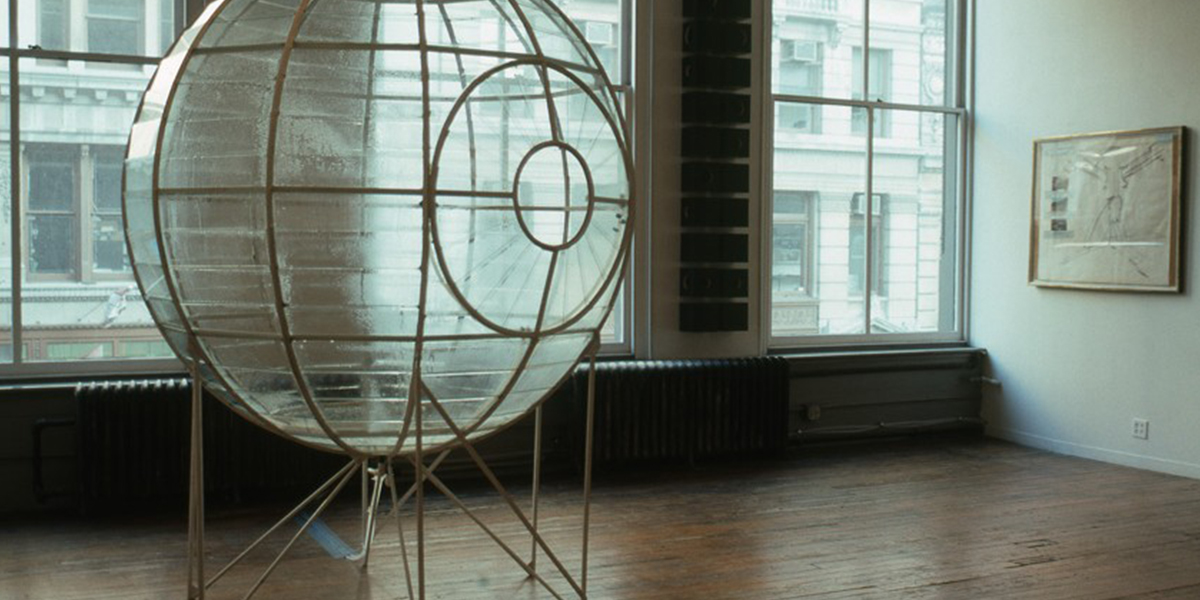
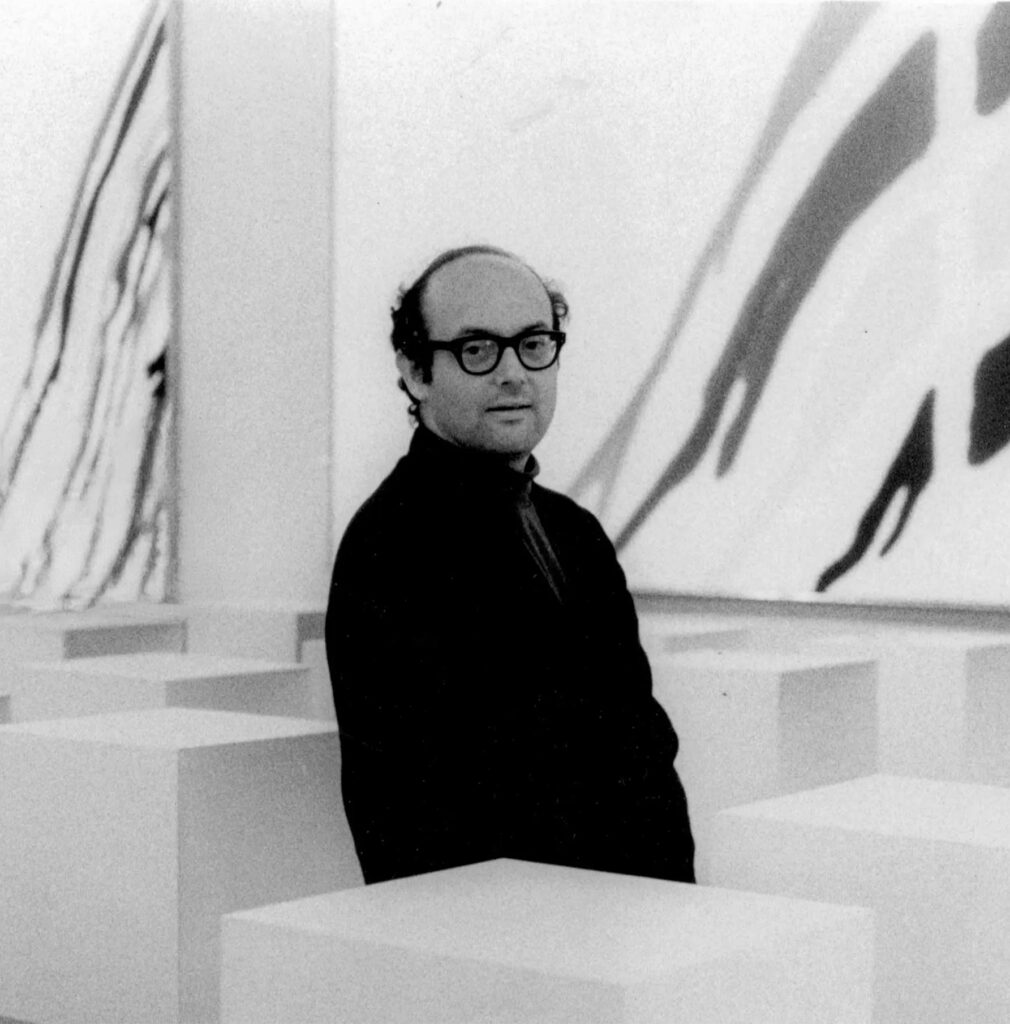
Sol LeWitt (1928–2003) was a foundational American artist whose work and theoretical writings were instrumental in the establishment of both Minimalism and Conceptual Art. After serving in the U.S. Army during the Korean War and later working as a graphic designer for architect I.M. Pei, LeWitt began to move away from traditional painting. He focused on "structures"—a term he preferred over "sculptures"—that utilized the cube as a basic modular unit. His practice was built on the belief that the "idea" or "concept" was the most important aspect of the work, famously stating in his 1967 essay Paragraphs on Conceptual Art that the execution is often a perfunctory affair.
LeWitt is perhaps best known for his Wall Drawings, a series of thousands of works executed directly on architectural surfaces. These works were unique because LeWitt did not always physically create them himself; instead, he authored a set of precise geometric instructions or diagrams that were then executed by other artists or drafters. This approach challenged traditional notions of authorship and the uniqueness of the art object, suggesting that the work of art exists primarily as a set of logical parameters. These instructions often involved complex combinations of lines in four directions, primary colors, and basic shapes that, despite their rigid rules, resulted in visually vibrant and expansive environments.
Sol LeWitt (1928–2003) was a foundational American artist whose work and theoretical writings were instrumental in the establishment of both Minimalism and Conceptual Art. After serving in the U.S. Army during the Korean War and later working as a graphic designer for architect I.M. Pei, LeWitt began to move away from traditional painting. He focused on "structures"—a term he preferred over "sculptures"—that utilized the cube as a basic modular unit. His practice was built on the belief that the "idea" or "concept" was the most important aspect of the work, famously stating in his 1967 essay Paragraphs on Conceptual Art that the execution is often a perfunctory affair.
LeWitt is perhaps best known for his Wall Drawings, a series of thousands of works executed directly on architectural surfaces. These works were unique because LeWitt did not always physically create them himself; instead, he authored a set of precise geometric instructions or diagrams that were then executed by other artists or drafters. This approach challenged traditional notions of authorship and the uniqueness of the art object, suggesting that the work of art exists primarily as a set of logical parameters. These instructions often involved complex combinations of lines in four directions, primary colors, and basic shapes that, despite their rigid rules, resulted in visually vibrant and expansive environments.
Over his decades-long career, LeWitt’s influence extended into public art, printmaking, and photography. His large-scale outdoor structures, often made of white cinder blocks or stainless steel, can be found in major cities and institutions worldwide, including the National Gallery of Art in Washington, D.C., and the San Francisco Museum of Modern Art. His work remains a cornerstone of contemporary art history, recognized for its intellectual rigor and its ability to transform simple mathematical systems into profound sensory experiences. Today, his legacy is maintained through permanent installations and traveling retrospectives that continue to execute his original instructions for new audiences.
SOL LEWITT
Sol LeWitt (1928–2003) was a foundational American artist whose work and theoretical writings were instrumental in the establishment of both Minimalism and Conceptual Art. After serving in the U.S. Army during the Korean War and later working as a graphic designer for architect I.M. Pei, LeWitt began to move...
Sol LeWitt (1928–2003) was a foundational American artist whose work and theoretical writings were instrumental in the establishment of both Minimalism and Conceptual Art. After serving in the U.S. Army during the Korean War and later working as a graphic designer for architect I.M. Pei, LeWitt began to move away from traditional painting. He focused on "structures"—a term he preferred over "sculptures"—that utilized the cube as a basic modular unit. His practice was built on the belief that the "idea" or "concept" was the most important aspect of the work, famously stating in his 1967 essay Paragraphs on Conceptual Art that the execution is often a perfunctory affair.
LeWitt is perhaps best known for his Wall Drawings, a series of thousands of works executed directly on architectural surfaces. These works were unique because LeWitt did not always physically create them himself; instead, he authored a set of precise geometric instructions or diagrams that were then executed by other artists or drafters. This approach challenged traditional notions of authorship and the uniqueness of the art object, suggesting that the work of art exists primarily as a set of logical parameters. These instructions often involved complex combinations of lines in four directions, primary colors, and basic shapes that, despite their rigid rules, resulted in visually vibrant and expansive environments.
Over his decades-long career, LeWitt’s influence extended into public art, printmaking, and photography. His large-scale outdoor structures, often made of white cinder blocks or stainless steel, can be found in major cities and institutions worldwide, including the National Gallery of Art in Washington, D.C., and the San Francisco Museum of Modern Art. His work remains a cornerstone of contemporary art history, recognized for its intellectual rigor and its ability to transform simple mathematical systems into profound sensory experiences. Today, his legacy is maintained through permanent installations and traveling retrospectives that continue to execute his original instructions for new audiences.
SOL LEWITT
Sol LeWitt (1928–2003) was a foundational American artist whose work and theoretical writings were instrumental in the establishment of both Minimalism and Conceptual Art. After serving in the U.S. Army during the Korean War and later working as a graphic designer for architect I.M. Pei, LeWitt began to move away from traditional painting. He focused on “structures”—a term he preferred over “sculptures”—that utilized the cube as a basic modular unit. His practice was built on the belief that the “idea” or “concept” was the most important aspect of the work, famously stating in his 1967 essay Paragraphs on Conceptual Art that the execution is often a perfunctory affair.
LeWitt is perhaps best known for his Wall Drawings, a series of thousands of works executed directly on architectural surfaces. These works were unique because LeWitt did not always physically create them himself; instead, he authored a set of precise geometric instructions or diagrams that were then executed by other artists or drafters. This approach challenged traditional notions of authorship and the uniqueness of the art object, suggesting that the work of art exists primarily as a set of logical parameters. These instructions often involved complex combinations of lines in four directions, primary colors, and basic shapes that, despite their rigid rules, resulted in visually vibrant and expansive environments.
Over his decades-long career, LeWitt’s influence extended into public art, printmaking, and photography. His large-scale outdoor structures, often made of white cinder blocks or stainless steel, can be found in major cities and institutions worldwide, including the National Gallery of Art in Washington, D.C., and the San Francisco Museum of Modern Art. His work remains a cornerstone of contemporary art history, recognized for its intellectual rigor and its ability to transform simple mathematical systems into profound sensory experiences. Today, his legacy is maintained through permanent installations and traveling retrospectives that continue to execute his original instructions for new audiences.
ARTWORK
ARTWORK
ARTWORK