SIR ANISH KAPOOR CBE RA
Born in 1954 in Bombay (now Mumbai), Anish Kapoor moved to London in the early 1970s. He received a BA in fine art at Hornsey College of Art and an MA in fine art at the Chelsea School of Art and Design. Kapoor studied under Paul Neagu, a Romanian-born artist who was instrumental in helping Kapoor articulate a cross-cultural artistic vision that would be a lasting foundation for his career.
Kapoor first came to wider attention in the group exhibition New Sculpture (1978) at the Hayward Gallery, London. The show featured several artists who were a part of the New British Sculpture movement, which broke from the Minimalism and Post-Minimalism of previous generations and instead infused art with postmodern viewpoints that include merging high and low art forms, using new technologies in unconventional ways, and greater recognition of cultural diversity.
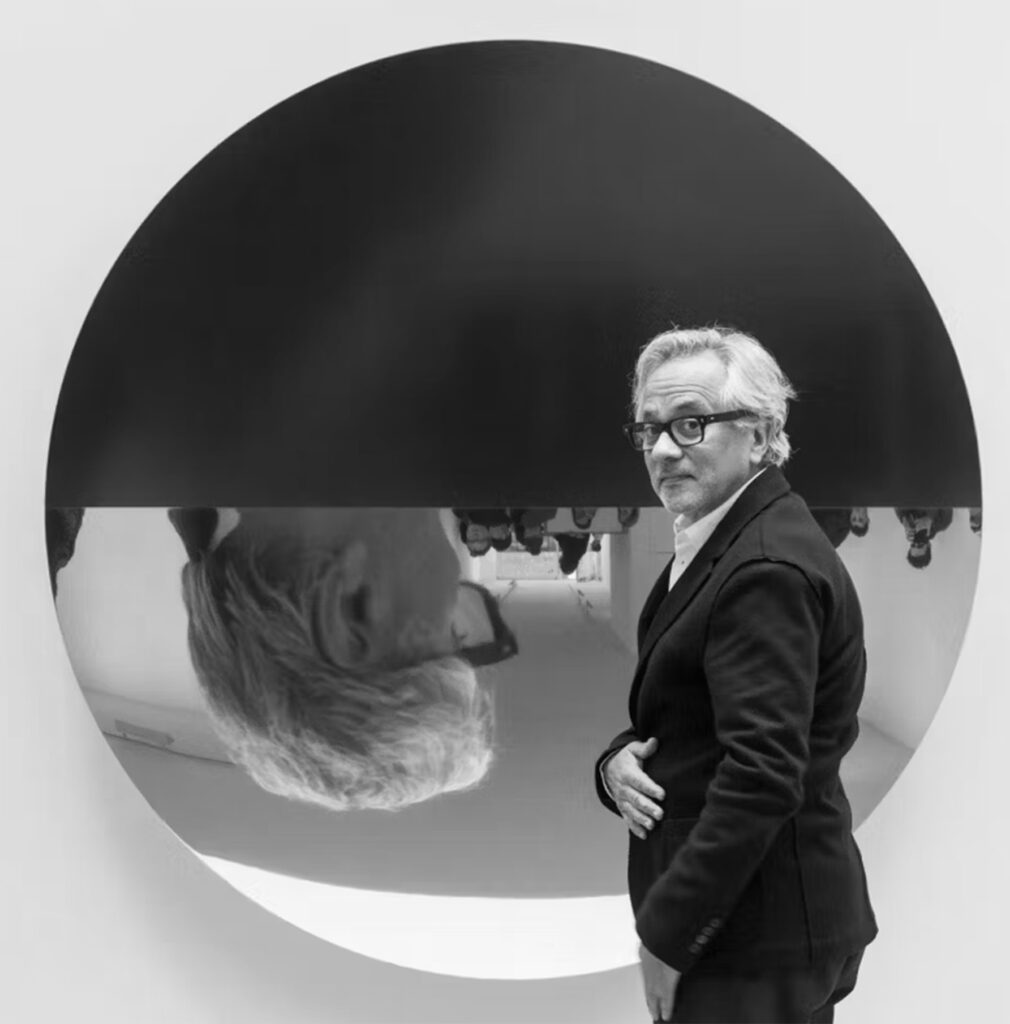
A sculptural innovator, Kapoor is particularly known for his unexpected use of terrene materials such as limestone, granite, dirt, concrete, and colorful pigment, along with his ability to create engaging environments that inspire a meditative, poetic experience. Kapoor fashions largely monochromatic and deceptively simple works that challenge ideas of rationality and perception through the interplay of curvilinear forms, reflective surfaces, and size. His works are grounded in Eastern metaphysics and often serve as evocative statements of perception, spirituality, the body...
Born in 1954 in Bombay (now Mumbai), Anish Kapoor moved to London in the early 1970s. He received a BA in fine art at Hornsey College of Art and an MA in fine art at the Chelsea School of Art and Design. Kapoor studied under Paul Neagu, a Romanian-born artist who was instrumental in helping Kapoor articulate a cross-cultural artistic vision that would be a lasting foundation for his career.
Kapoor first came to wider attention in the group exhibition New Sculpture (1978) at the Hayward Gallery, London. The show featured several artists who were a part of the New British Sculpture movement, which broke from the Minimalism and Post-Minimalism of previous generations and instead infused art with postmodern viewpoints that include merging high and low art forms, using new technologies in unconventional ways, and greater recognition of cultural diversity.
A sculptural innovator, Kapoor is particularly known for his unexpected use of terrene materials such as limestone, granite, dirt, concrete, and colorful pigment, along with his ability to create engaging environments that inspire a meditative, poetic experience. Kapoor fashions largely monochromatic and deceptively simple works that challenge ideas of rationality and perception through the interplay of curvilinear forms, reflective surfaces, and size. His works are grounded in Eastern metaphysics and often serve as evocative statements of perception, spirituality, the body, the mind, as well as yin-and-yang dualities inherent in nature. In the mid-1990s his works became more ambitious in scale, and he began exploring industrial materials such as PVC, fiberglass, and steel. In creating larger, monumental works, Kapoor began to integrate his sculpture and installations more fully within the surrounding environment. Shown at the Tate Modern, London, Marsyas (2002), a sinuous, hollowed-out, blood-red stretched membrane that has three tuba-like openings, spanned the entire length of the 3,400-square-foot Turbine Hall, and Dirty Corner (2011), a nearly 200-foot tubular steel structure installed at the Fabbrica del Vapore, Milan, also dominates and envelops its venue.
Kapoor has completed several commissioned public installations, such as his first permanent site-specific installation in the United States, Cloud Gate (2004), which is commonly known as the “Bean,” in Chicago. Among other public works, he created Sky Mirror (2006) in New York, Cinema di Terra (2009) in the Parco Nazionale del Pollino in southern Italy, and Leviathan (2011) at the Grand Palais in Paris. He has received numerous international awards and honors, including the Premio Duemila, Venice Biennale (representing Britain, 1990); Turner Prize, Tate Gallery, London (1991); and Praemium Imperiale, Japan Art Association (2011). In 2003 he was given the title of Commander of the British Empire and in 2011 Commandeur in the Ordre des Arts et des Lettres. Commissioned by and presented at the Deutsche Guggenheim, Berlin, Memory (2008–09), a 24-ton Cor-Ten steel tank traveled to the Guggenheim Museum in 2009. Kapoor has also had solo exhibitions at the Institute of Contemporary Art, Boston (2008); Royal Academy of Arts, London (2009); National Gallery of Modern Art, New Delhi (2010); Guggenheim Museum Bilbao (2010); and the École national supérieure des beaux-arts de Paris (2011). Kapoor lives and works in London.
SIR ANISH KAPOOR CBE RA
Born in 1954 in Bombay (now Mumbai), Anish Kapoor moved to London in the early 1970s. He received a BA in fine art at Hornsey College of Art and an MA...
Born in 1954 in Bombay (now Mumbai), Anish Kapoor moved to London in the early 1970s. He received a BA in fine art at Hornsey College of Art and an MA in fine art at the Chelsea School of Art and Design. Kapoor studied under Paul Neagu, a Romanian-born artist who was instrumental in helping Kapoor articulate a cross-cultural artistic vision that would be a lasting foundation for his career.
Kapoor first came to wider attention in the group exhibition New Sculpture (1978) at the Hayward Gallery, London. The show featured several artists who were a part of the New British Sculpture movement, which broke from the Minimalism and Post-Minimalism of previous generations and instead infused art with postmodern viewpoints that include merging high and low art forms, using new technologies in unconventional ways, and greater recognition of cultural diversity.
A sculptural innovator, Kapoor is particularly known for his unexpected use of terrene materials such as limestone, granite, dirt, concrete, and colorful pigment, along with his ability to create engaging environments that inspire a meditative, poetic experience. Kapoor fashions largely monochromatic and deceptively simple works that challenge ideas of rationality and perception through the interplay of curvilinear forms, reflective surfaces, and size. His works are grounded in Eastern metaphysics and often serve as evocative statements of perception, spirituality, the body, the mind, as well as yin-and-yang dualities inherent in nature. In the mid-1990s his works became more ambitious in scale, and he began exploring industrial materials such as PVC, fiberglass, and steel. In creating larger, monumental works, Kapoor began to integrate his sculpture and installations more fully within the surrounding environment. Shown at the Tate Modern, London, Marsyas (2002), a sinuous, hollowed-out, blood-red stretched membrane that has three tuba-like openings, spanned the entire length of the 3,400-square-foot Turbine Hall, and Dirty Corner (2011), a nearly 200-foot tubular steel structure installed at the Fabbrica del Vapore, Milan, also dominates and envelops its venue.
Kapoor has completed several commissioned public installations, such as his first permanent site-specific installation in the United States, Cloud Gate (2004), which is commonly known as the “Bean,” in Chicago. Among other public works, he created Sky Mirror (2006) in New York, Cinema di Terra (2009) in the Parco Nazionale del Pollino in southern Italy, and Leviathan (2011) at the Grand Palais in Paris. He has received numerous international awards and honors, including the Premio Duemila, Venice Biennale (representing Britain, 1990); Turner Prize, Tate Gallery, London (1991); and Praemium Imperiale, Japan Art Association (2011). In 2003 he was given the title of Commander of the British Empire and in 2011 Commandeur in the Ordre des Arts et des Lettres. Commissioned by and presented at the Deutsche Guggenheim, Berlin, Memory (2008–09), a 24-ton Cor-Ten steel tank traveled to the Guggenheim Museum in 2009. Kapoor has also had solo exhibitions at the Institute of Contemporary Art, Boston (2008); Royal Academy of Arts, London (2009); National Gallery of Modern Art, New Delhi (2010); Guggenheim Museum Bilbao (2010); and the École national supérieure des beaux-arts de Paris (2011). Kapoor lives and works in London.
SIR ANISH KAPOOR CBE RA
Born in 1954 in Bombay (now Mumbai), Anish Kapoor moved to London in the early 1970s. He received a BA in fine art at Hornsey College of Art and an MA in fine art at the Chelsea School of Art and Design. Kapoor studied under Paul Neagu, a Romanian-born artist who was instrumental in helping Kapoor articulate a cross-cultural artistic vision that would be a lasting foundation for his career.
Kapoor first came to wider attention in the group exhibition New Sculpture (1978) at the Hayward Gallery, London. The show featured several artists who were a part of the New British Sculpture movement, which broke from the Minimalism and Post-Minimalism of previous generations and instead infused art with postmodern viewpoints that include merging high and low art forms, using new technologies in unconventional ways, and greater recognition of cultural diversity.
A sculptural innovator, Kapoor is particularly known for his unexpected use of terrene materials such as limestone, granite, dirt, concrete, and colorful pigment, along with his ability to create engaging environments that inspire a meditative, poetic experience. Kapoor fashions largely monochromatic and deceptively simple works that challenge ideas of rationality and perception through the interplay of curvilinear forms, reflective surfaces, and size. His works are grounded in Eastern metaphysics and often serve as evocative statements of perception, spirituality, the body, the mind, as well as yin-and-yang dualities inherent in nature. In the mid-1990s his works became more ambitious in scale, and he began exploring industrial materials such as PVC, fiberglass, and steel. In creating larger, monumental works, Kapoor began to integrate his sculpture and installations more fully within the surrounding environment. Shown at the Tate Modern, London, Marsyas (2002), a sinuous, hollowed-out, blood-red stretched membrane that has three tuba-like openings, spanned the entire length of the 3,400-square-foot Turbine Hall, and Dirty Corner (2011), a nearly 200-foot tubular steel structure installed at the Fabbrica del Vapore, Milan, also dominates and envelops its venue.
Kapoor has completed several commissioned public installations, such as his first permanent site-specific installation in the United States, Cloud Gate (2004), which is commonly known as the “Bean,” in Chicago. Among other public works, he created Sky Mirror (2006) in New York, Cinema di Terra (2009) in the Parco Nazionale del Pollino in southern Italy, and Leviathan (2011) at the Grand Palais in Paris. He has received numerous international awards and honors, including the Premio Duemila, Venice Biennale (representing Britain, 1990); Turner Prize, Tate Gallery, London (1991); and Praemium Imperiale, Japan Art Association (2011). In 2003 he was given the title of Commander of the British Empire and in 2011 Commandeur in the Ordre des Arts et des Lettres. Commissioned by and presented at the Deutsche Guggenheim, Berlin, Memory (2008–09), a 24-ton Cor-Ten steel tank traveled to the Guggenheim Museum in 2009. Kapoor has also had solo exhibitions at the Institute of Contemporary Art, Boston (2008); Royal Academy of Arts, London (2009); National Gallery of Modern Art, New Delhi (2010); Guggenheim Museum Bilbao (2010); and the École national supérieure des beaux-arts de Paris (2011). Kapoor lives and works in London.
ARTWORK
ARTWORK
ARTWORK