TATSUO MIYAJIMA
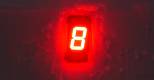
Tatsuo Miyajima (born 1957) is a prominent Japanese contemporary artist known for his immersive installations that utilize modern technology to explore Buddhist philosophy and the cyclical nature of time. After graduating from the Tokyo University of the Arts in 1986, Miyajima moved away from traditional painting and performance art toward the use of light-emitting diodes (LEDs). His signature medium consists of digital counters that cycle through numbers 1 to 9 at varying speeds. Crucially, his counters never display the number 0, which Miyajima uses to represent "death" or a void—a pause before the cycle of life begins again.
Miyajima’s work is governed by three core concepts: "Keep Changing," "Connect with Everything," and "Continue Forever." These principles are exemplified in large-scale installations like Mega Death (1999), presented at the Venice Biennale, which featured a massive wall of blue LEDs that would occasionally blink out simultaneously, creating a profound moment of darkness to commemorate the lives lost in 20th-century conflicts. Another significant project, Sea of Time (1998), was created for the Naoshima Art House Project, where he worked with local residents to set the speeds of 125 digital counters submerged in a pool of water, effectively mapping individual rhythms onto a collective experience.
Throughout his career, Miyajima has held major solo exhibitions at institutions such as...
Tatsuo Miyajima (born 1957) is a prominent Japanese contemporary artist known for his immersive installations that utilize modern technology to explore Buddhist philosophy and the cyclical nature of time. After graduating from the Tokyo University of the Arts in 1986, Miyajima moved away from traditional painting and performance art toward the use of light-emitting diodes (LEDs). His signature medium consists of digital counters that cycle through numbers 1 to 9 at varying speeds. Crucially, his counters never display the number 0, which Miyajima uses to represent "death" or a void—a pause before the cycle of life begins again.
Miyajima’s work is governed by three core concepts: "Keep Changing," "Connect with Everything," and "Continue Forever." These principles are exemplified in large-scale installations like Mega Death (1999), presented at the Venice Biennale, which featured a massive wall of blue LEDs that would occasionally blink out simultaneously, creating a profound moment of darkness to commemorate the lives lost in 20th-century conflicts. Another significant project, Sea of Time (1998), was created for the Naoshima Art House Project, where he worked with local residents to set the speeds of 125 digital counters submerged in a pool of water, effectively mapping individual rhythms onto a collective experience.
Throughout his career, Miyajima has held major solo exhibitions at institutions such as the Hayward Gallery in London, the Museum of Contemporary Art Australia, and the Santa Monica Museum of Art. His practice extends into social activism through projects like the Kaki Tree Project, which distributes saplings from a persimmon tree that survived the atomic bombing of Nagasaki to be planted worldwide as symbols of peace. By bridging the gap between high-tech materials and ancient metaphysical questions, Miyajima remains a central figure in international contemporary art, exploring the interconnectedness of human life and the infinite cosmos.
TATSUO MIYAJIMA
Tatsuo Miyajima (born 1957) is a prominent Japanese contemporary artist known for his immersive installations that utilize modern technology to explore Buddhist philosophy and the cyclical nature of time. After graduating from the...
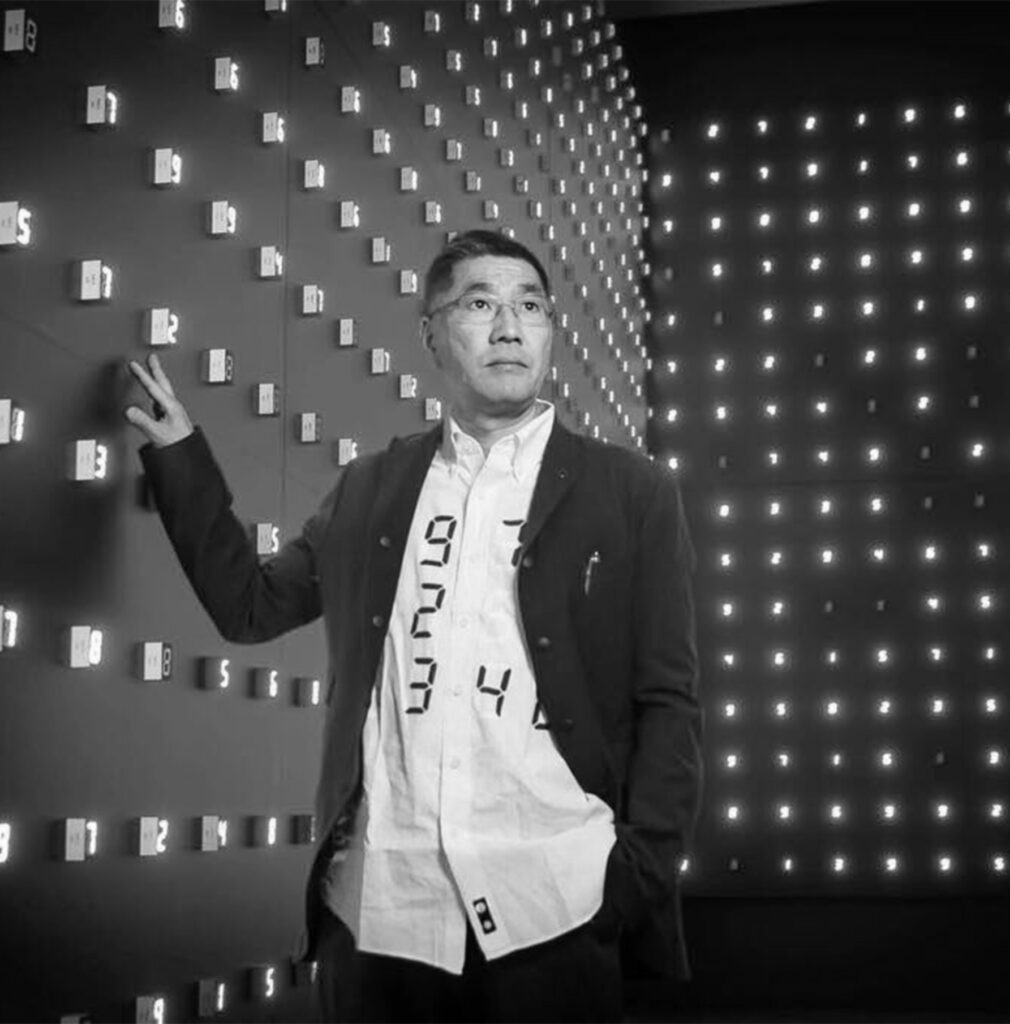
Tatsuo Miyajima (born 1957) is a prominent Japanese contemporary artist known for his immersive installations that utilize modern technology to explore Buddhist philosophy and the cyclical nature of time. After graduating from the Tokyo University of the Arts in 1986, Miyajima moved away from traditional painting and performance art toward the use of light-emitting diodes (LEDs). His signature medium consists of digital counters that cycle through numbers 1 to 9 at varying speeds. Crucially, his counters never display the number 0, which Miyajima uses to represent "death" or a void—a pause before the cycle of life begins again.
Miyajima’s work is governed by three core concepts: "Keep Changing," "Connect with Everything," and "Continue Forever." These principles are exemplified in large-scale installations like Mega Death (1999), presented at the Venice Biennale, which featured a massive wall of blue LEDs that would occasionally blink out simultaneously, creating a profound moment of darkness to commemorate the lives lost in 20th-century conflicts. Another significant project, Sea of Time (1998), was created for the Naoshima Art House Project, where he worked with local residents to set the speeds of 125 digital counters submerged in a pool of water, effectively mapping individual rhythms onto a collective experience.
Throughout his career, Miyajima has held major solo exhibitions at institutions such as the Hayward Gallery in London, the Museum of Contemporary Art Australia, and the Santa Monica Museum of Art. His practice extends into social activism through projects like the Kaki Tree Project, which distributes saplings from a persimmon tree that survived the atomic bombing of Nagasaki to be planted worldwide as symbols of peace. By bridging the gap between high-tech materials and ancient metaphysical questions, Miyajima remains a central figure in international contemporary art, exploring the interconnectedness of human life and the infinite cosmos.
TATSUO MIYAJIMA
Tatsuo Miyajima (born 1957) is a prominent Japanese contemporary artist known for his immersive installations that utilize modern technology to explore Buddhist philosophy and the cyclical nature of time. After graduating from the Tokyo University of the Arts in 1986, Miyajima moved away from traditional painting and performance art toward the use of light-emitting diodes (LEDs). His signature medium consists of digital counters that cycle through numbers 1 to 9 at varying speeds. Crucially, his counters never display the number 0, which Miyajima uses to represent “death” or a void—a pause before the cycle of life begins again.
Miyajima’s work is governed by three core concepts: “Keep Changing,” “Connect with Everything,” and “Continue Forever.” These principles are exemplified in large-scale installations like Mega Death (1999), presented at the Venice Biennale, which featured a massive wall of blue LEDs that would occasionally blink out simultaneously, creating a profound moment of darkness to commemorate the lives lost in 20th-century conflicts. Another significant project, Sea of Time (1998), was created for the Naoshima Art House Project, where he worked with local residents to set the speeds of 125 digital counters submerged in a pool of water, effectively mapping individual rhythms onto a collective experience.
Throughout his career, Miyajima has held major solo exhibitions at institutions such as the Hayward Gallery in London, the Museum of Contemporary Art Australia, and the Santa Monica Museum of Art. His practice extends into social activism through projects like the Kaki Tree Project, which distributes saplings from a persimmon tree that survived the atomic bombing of Nagasaki to be planted worldwide as symbols of peace. By bridging the gap between high-tech materials and ancient metaphysical questions, Miyajima remains a central figure in international contemporary art, exploring the interconnectedness of human life and the infinite cosmos.
ARTWORK
ARTWORK
ARTWORK