
DO HO SUH
Born in 1962 in Seoul, Do Ho Suh is a prominent South Korean contemporary artist known for his immersive installations and sculptures that examine the concepts of home, cultural displacement, and the boundaries of identity. The son of the late traditional painter Suh Se-ok, he began his education at Seoul National University before moving to the United States to study at the Rhode Island School of Design and Yale University. This personal history of migration between Seoul, New York, Berlin, and London serves as the primary catalyst for his work, which often reconstructs the specific domestic spaces he has inhabited throughout his itinerant life.
Suh is most celebrated for his meticulously hand-sewn, full-scale architectural replicas made from translucent monochrome fabrics like silk and polyester. These ethereal, "portable" structures—often featuring intricate details such as light switches, door handles, and radiator pipes—challenge traditional notions of architecture as permanent or solid. By rendering heavy buildings in weightless material, he explores the psychological "skin" of architecture and how individuals carry memories of physical space with them across borders.
Beyond his fabric architecture, Suh’s practice frequently addresses the relationship between the individual and the collective, often informed by his mandatory military service in South Korea. Works like Some/One, a hollow suit of armor constructed...
Born in 1962 in Seoul, Do Ho Suh is a prominent South Korean contemporary artist known for his immersive installations and sculptures that examine the concepts of home, cultural displacement, and the boundaries of identity. The son of the late traditional painter Suh Se-ok, he began his education at Seoul National University before moving to the United States to study at the Rhode Island School of Design and Yale University. This personal history of migration between Seoul, New York, Berlin, and London serves as the primary catalyst for his work, which often reconstructs the specific domestic spaces he has inhabited throughout his itinerant life.
Suh is most celebrated for his meticulously hand-sewn, full-scale architectural replicas made from translucent monochrome fabrics like silk and polyester. These ethereal, "portable" structures—often featuring intricate details such as light switches, door handles, and radiator pipes—challenge traditional notions of architecture as permanent or solid. By rendering heavy buildings in weightless material, he explores the psychological "skin" of architecture and how individuals carry memories of physical space with them across borders.
Beyond his fabric architecture, Suh’s practice frequently addresses the relationship between the individual and the collective, often informed by his mandatory military service in South Korea. Works like Some/One, a hollow suit of armor constructed from thousands of military dog tags, or Floor, where glass plates are supported by a multitude of tiny human figures, reflect a preoccupation with how personal identity is both supported by and submerged within a larger group. His work has been exhibited at major institutions globally, including the Tate Modern, the Guggenheim Museum, and the National Museum of Modern and Contemporary Art in Seoul.
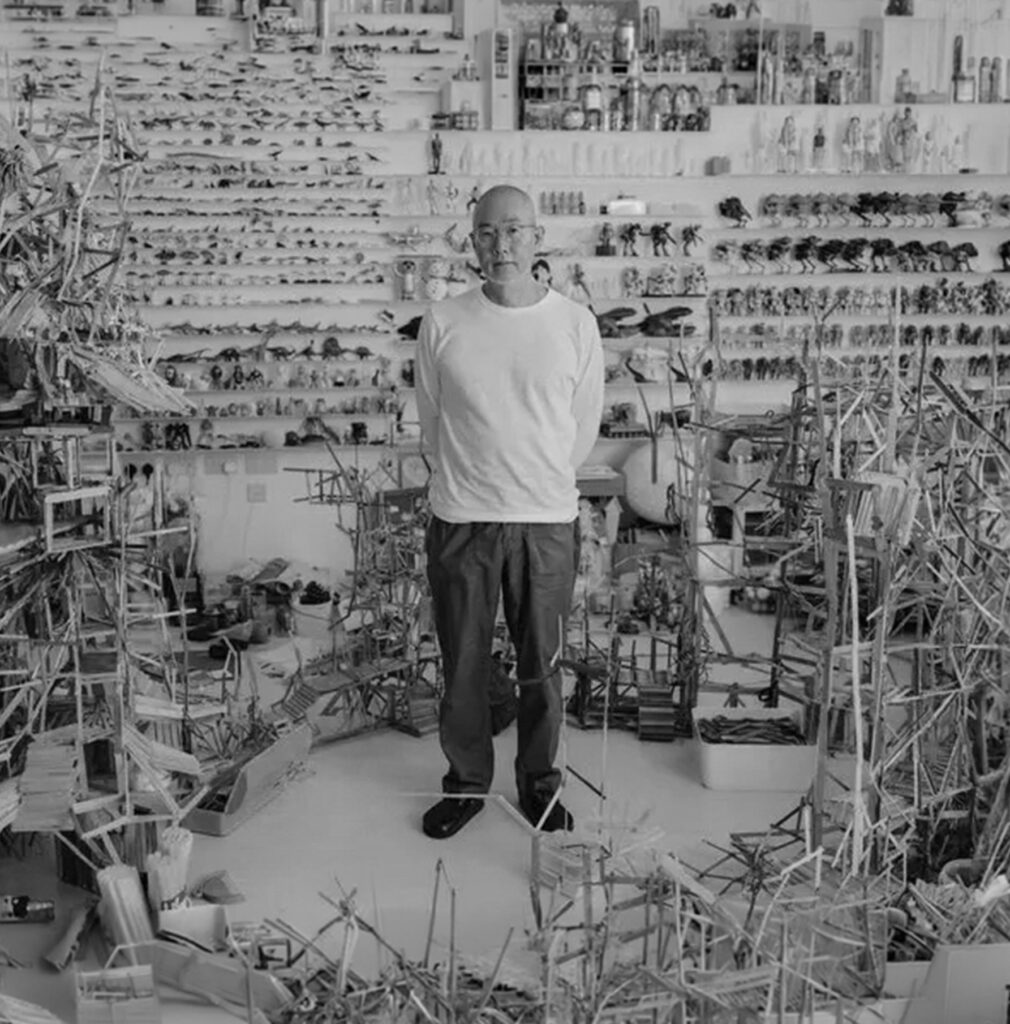
DO HO SUH
Born in 1962 in Seoul, Do Ho Suh is a prominent South Korean contemporary artist known for his immersive installations and sculptures that examine the concepts of home, cultural displacement, and the boundaries of identity. The son of the late traditional painter Suh Se-ok, he began his education at Seoul National University...
Born in 1962 in Seoul, Do Ho Suh is a prominent South Korean contemporary artist known for his immersive installations and sculptures that examine the concepts of home, cultural displacement, and the boundaries of identity. The son of the late traditional painter Suh Se-ok, he began his education at Seoul National University before moving to the United States to study at the Rhode Island School of Design and Yale University. This personal history of migration between Seoul, New York, Berlin, and London serves as the primary catalyst for his work, which often reconstructs the specific domestic spaces he has inhabited throughout his itinerant life.
Suh is most celebrated for his meticulously hand-sewn, full-scale architectural replicas made from translucent monochrome fabrics like silk and polyester. These ethereal, "portable" structures—often featuring intricate details such as light switches, door handles, and radiator pipes—challenge traditional notions of architecture as permanent or solid. By rendering heavy buildings in weightless material, he explores the psychological "skin" of architecture and how individuals carry memories of physical space with them across borders.
Beyond his fabric architecture, Suh’s practice frequently addresses the relationship between the individual and the collective, often informed by his mandatory military service in South Korea. Works like Some/One, a hollow suit of armor constructed from thousands of military dog tags, or Floor, where glass plates are supported by a multitude of tiny human figures, reflect a preoccupation with how personal identity is both supported by and submerged within a larger group. His work has been exhibited at major institutions globally, including the Tate Modern, the Guggenheim Museum, and the National Museum of Modern and Contemporary Art in Seoul.
DO HO SUH
Born in 1962 in Seoul, Do Ho Suh is a prominent South Korean contemporary artist known for his immersive installations and sculptures that examine the concepts of home, cultural displacement, and the boundaries of identity. The son of the late traditional painter Suh Se-ok, he began his education at Seoul National University before moving to the United States to study at the Rhode Island School of Design and Yale University. This personal history of migration between Seoul, New York, Berlin, and London serves as the primary catalyst for his work, which often reconstructs the specific domestic spaces he has inhabited throughout his itinerant life.
Suh is most celebrated for his meticulously hand-sewn, full-scale architectural replicas made from translucent monochrome fabrics like silk and polyester. These ethereal, “portable” structures—often featuring intricate details such as light switches, door handles, and radiator pipes—challenge traditional notions of architecture as permanent or solid. By rendering heavy buildings in weightless material, he explores the psychological “skin” of architecture and how individuals carry memories of physical space with them across borders.
Beyond his fabric architecture, Suh’s practice frequently addresses the relationship between the individual and the collective, often informed by his mandatory military service in South Korea. Works like Some/One, a hollow suit of armor constructed from thousands of military dog tags, or Floor, where glass plates are supported by a multitude of tiny human figures, reflect a preoccupation with how personal identity is both supported by and submerged within a larger group. His work has been exhibited at major institutions globally, including the Tate Modern, the Guggenheim Museum, and the National Museum of Modern and Contemporary Art in Seoul.
ARTWORK
ARTWORK
ARTWORK
