
LAWRENCE WEINER
Lawrence Weiner (1942–2021) was a central figure in the formation of Conceptual Art, known for redefining the traditional relationship between the artist, the object, and the viewer. Born in the Bronx, New York, Weiner initially experimented with painting and sculpture—most notably his Propeller Paintings and site-specific "removals" from landscape—before reaching a pivotal realization in 1968. He concluded that the idea or description of a work of art could function as the artwork itself, regardless of its physical manifestation. This led to his landmark "Declaration of Intent," which stated that a work may be constructed by the artist, produced by others, or not built at all, with each state being equal and consistent with the artist's intent.
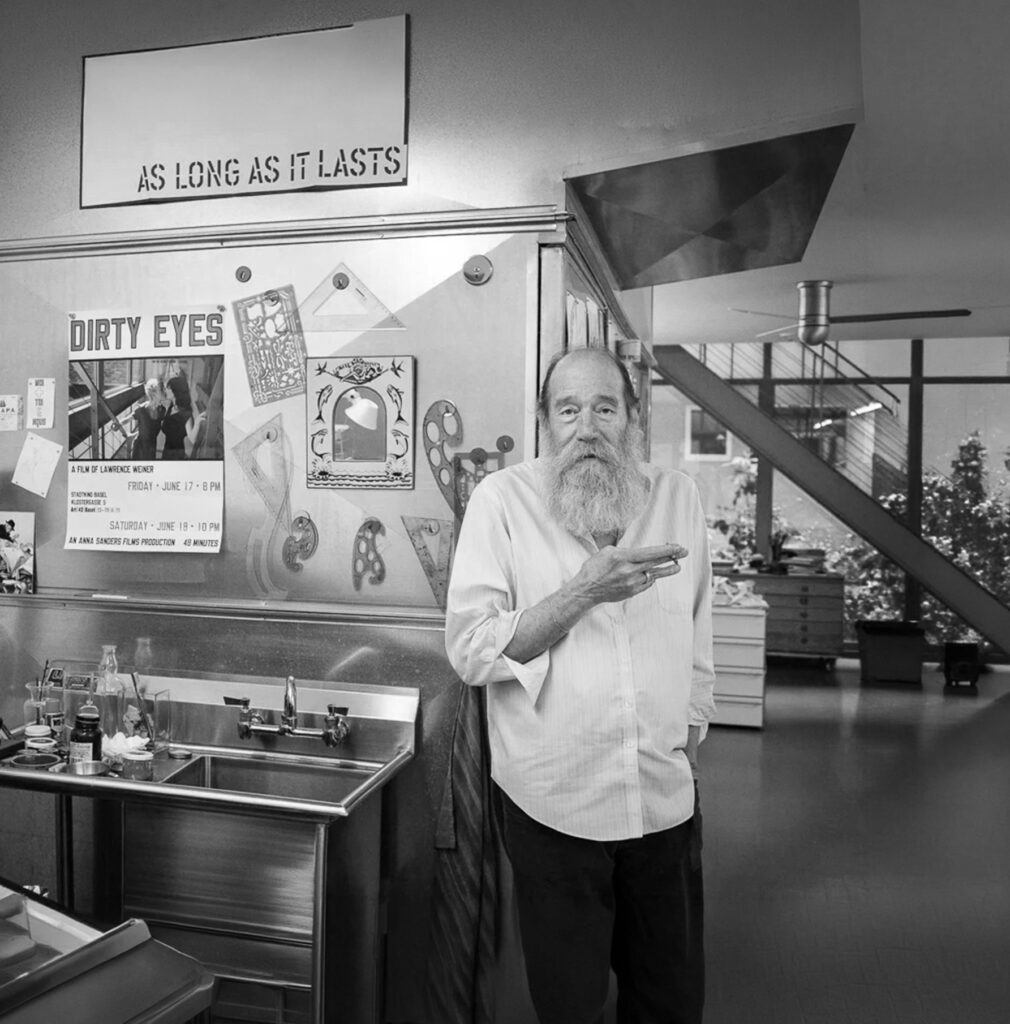
His primary medium became language, which he referred to as "sculptural material." Weiner’s works, which he titled "Statements," consisted of objective descriptions of processes, materials, or spatial relationships, such as A Wall Pitted by a Single Air Rifle Shot or Bits & Pieces Put Together to Present a Semblance of a Whole. These were often rendered in a signature sans-serif typeface on the walls of galleries, public buildings, or even everyday objects like manhole covers and posters. By stripping art down to linguistic propositions, he sought to remove the "signature" of the artist's hand and allow the work to be interpreted and "completed" by the viewer within their own mental or physical space.
Lawrence Weiner (1942–2021) was a central figure in the formation of Conceptual Art, known for redefining the traditional relationship between the artist, the object, and the viewer. Born in the Bronx, New York, Weiner initially experimented with painting and sculpture—most notably his Propeller Paintings and site-specific "removals" from landscape—before reaching a pivotal realization in 1968. He concluded that the idea or description of a work of art could function as the artwork itself, regardless of its physical manifestation. This led to his landmark "Declaration of Intent," which stated that a work may be constructed by the artist, produced by others, or not built at all, with each state being equal and consistent with the artist's intent.
His primary medium became language, which he referred to as "sculptural material." Weiner’s works, which he titled "Statements," consisted of objective descriptions of processes, materials, or spatial relationships, such as A Wall Pitted by a Single Air Rifle Shot or Bits & Pieces Put Together to Present a Semblance of a Whole. These were often rendered in a signature sans-serif typeface on the walls of galleries, public buildings, or even everyday objects like manhole covers and posters. By stripping art down to linguistic propositions, he sought to remove the "signature" of the artist's hand and allow the work to be interpreted and "completed" by the viewer within their own mental or physical space.
Weiner's influence on contemporary art was immense, spanning over five decades of international exhibitions, including Documenta and several Venice Biennales. His work is characterized by its democratic accessibility; because his statements could be translated into any language and applied to any surface, they bypassed the exclusivity of the traditional art market. Major retrospectives of his work have been held at institutions such as the Whitney Museum of American Art in New York and the Stedelijk Museum in Amsterdam. Until his death, Weiner remained committed to the idea that art is a fundamental tool for navigating the world, famously asserting that "Art is not a metaphor for the relationship of human beings to objects and objects to objects in relation to human beings, but a representation of an empirical existing fact."
LAWRENCE WEINER
Lawrence Weiner (1942–2021) was a central figure in the formation of Conceptual Art, known for redefining the traditional relationship between the artist, the object, and the viewer. Born in the Bronx, New York, Weiner initially...
Lawrence Weiner (1942–2021) was a central figure in the formation of Conceptual Art, known for redefining the traditional relationship between the artist, the object, and the viewer. Born in the Bronx, New York, Weiner initially experimented with painting and sculpture—most notably his Propeller Paintings and site-specific "removals" from landscape—before reaching a pivotal realization in 1968. He concluded that the idea or description of a work of art could function as the artwork itself, regardless of its physical manifestation. This led to his landmark "Declaration of Intent," which stated that a work may be constructed by the artist, produced by others, or not built at all, with each state being equal and consistent with the artist's intent.
His primary medium became language, which he referred to as "sculptural material." Weiner’s works, which he titled "Statements," consisted of objective descriptions of processes, materials, or spatial relationships, such as A Wall Pitted by a Single Air Rifle Shot or Bits & Pieces Put Together to Present a Semblance of a Whole. These were often rendered in a signature sans-serif typeface on the walls of galleries, public buildings, or even everyday objects like manhole covers and posters. By stripping art down to linguistic propositions, he sought to remove the "signature" of the artist's hand and allow the work to be interpreted and "completed" by the viewer within their own mental or physical space.
Weiner's influence on contemporary art was immense, spanning over five decades of international exhibitions, including Documenta and several Venice Biennales. His work is characterized by its democratic accessibility; because his statements could be translated into any language and applied to any surface, they bypassed the exclusivity of the traditional art market. Major retrospectives of his work have been held at institutions such as the Whitney Museum of American Art in New York and the Stedelijk Museum in Amsterdam. Until his death, Weiner remained committed to the idea that art is a fundamental tool for navigating the world, famously asserting that "Art is not a metaphor for the relationship of human beings to objects and objects to objects in relation to human beings, but a representation of an empirical existing fact."
LAWRENCE WEINER
Lawrence Weiner (1942–2021) was a central figure in the formation of Conceptual Art, known for redefining the traditional relationship between the artist, the object, and the viewer. Born in the Bronx, New York, Weiner initially experimented with painting and sculpture—most notably his Propeller Paintings and site-specific “removals” from landscape—before reaching a pivotal realization in 1968. He concluded that the idea or description of a work of art could function as the artwork itself, regardless of its physical manifestation. This led to his landmark “Declaration of Intent,” which stated that a work may be constructed by the artist, produced by others, or not built at all, with each state being equal and consistent with the artist’s intent.
His primary medium became language, which he referred to as “sculptural material.” Weiner’s works, which he titled “Statements,” consisted of objective descriptions of processes, materials, or spatial relationships, such as A Wall Pitted by a Single Air Rifle Shot or Bits & Pieces Put Together to Present a Semblance of a Whole. These were often rendered in a signature sans-serif typeface on the walls of galleries, public buildings, or even everyday objects like manhole covers and posters. By stripping art down to linguistic propositions, he sought to remove the “signature” of the artist’s hand and allow the work to be interpreted and “completed” by the viewer within their own mental or physical space.
Weiner’s influence on contemporary art was immense, spanning over five decades of international exhibitions, including Documenta and several Venice Biennales. His work is characterized by its democratic accessibility; because his statements could be translated into any language and applied to any surface, they bypassed the exclusivity of the traditional art market. Major retrospectives of his work have been held at institutions such as the Whitney Museum of American Art in New York and the Stedelijk Museum in Amsterdam. Until his death, Weiner remained committed to the idea that art is a fundamental tool for navigating the world, famously asserting that “Art is not a metaphor for the relationship of human beings to objects and objects to objects in relation to human beings, but a representation of an empirical existing fact.”