TADAO ANDO
Tadao Ando (born 1941) is a self-taught Japanese architect and winner of the 1995 Pritzker Architecture Prize, renowned for his mastery of light, space, and cast-in-place concrete. Originally a professional boxer and truck driver, Ando chose to pursue architecture by visiting iconic buildings across Europe, Africa, and the United States, developing a philosophy deeply rooted in Zen Buddhist concepts of simplicity and the "haiku" effect. His work is characterized by the use of smooth, silk-like concrete—often marked by the visible holes of formwork ties—and a commitment to "critical regionalism," which seeks to balance global modernism with the specific cultural and natural geography of a site.
Ando's architectural language frequently employs geometric forms that define and enclose space, creating a physical boundary between the chaotic urban environment and a tranquil interior. Notable examples of this approach include the Church of the Light (1989) in Osaka, where a cruciform opening in a concrete wall allows light to define the spiritual space, and the Chichu Art Museum (2004) in Naoshima, which is built entirely underground to preserve the natural landscape of the Seto Inland Sea. His designs often incorporate natural elements like water and wind, treating them as structural components that change the character of the building throughout the day.
Over a career spanning more than five decades, Ando has completed major...
Tadao Ando (born 1941) is a self-taught Japanese architect and winner of the 1995 Pritzker Architecture Prize, renowned for his mastery of light, space, and cast-in-place concrete. Originally a professional boxer and truck driver, Ando chose to pursue architecture by visiting iconic buildings across Europe, Africa, and the United States, developing a philosophy deeply rooted in Zen Buddhist concepts of simplicity and the "haiku" effect. His work is characterized by the use of smooth, silk-like concrete—often marked by the visible holes of formwork ties—and a commitment to "critical regionalism," which seeks to balance global modernism with the specific cultural and natural geography of a site.
Ando's architectural language frequently employs geometric forms that define and enclose space, creating a physical boundary between the chaotic urban environment and a tranquil interior. Notable examples of this approach include the Church of the Light (1989) in Osaka, where a cruciform opening in a concrete wall allows light to define the spiritual space, and the Chichu Art Museum (2004) in Naoshima, which is built entirely underground to preserve the natural landscape of the Seto Inland Sea. His designs often incorporate natural elements like water and wind, treating them as structural components that change the character of the building throughout the day.
Over a career spanning more than five decades, Ando has completed major international commissions, including the Modern Art Museum of Fort Worth, the Punta della Dogana in Venice, and the Bourse de Commerce in Paris. His influence extends beyond physical structures through his advocacy for environmental reforestation and his role as a professor emeritus at the University of Tokyo. Recognized with the AIA Gold Medal and the Kyoto Prize, Ando’s work remains a benchmark for contemporary minimalism, celebrated for its ability to evoke profound emotional and spiritual responses through the sophisticated manipulation of void and materiality.
TADAO ANDO
Tadao Ando (born 1941) is a self-taught Japanese architect and winner of the 1995 Pritzker Architecture Prize, renowned for his mastery of light, space, and cast-in-place concrete. Originally a professional boxer and truck driver, Ando chose to pursue architecture by visiting iconic buildings across Europe, Africa, and the...
Tadao Ando (born 1941) is a self-taught Japanese architect and winner of the 1995 Pritzker Architecture Prize, renowned for his mastery of light, space, and cast-in-place concrete. Originally a professional boxer and truck driver, Ando chose to pursue architecture by visiting iconic buildings across Europe, Africa, and the United States, developing a philosophy deeply rooted in Zen Buddhist concepts of simplicity and the "haiku" effect. His work is characterized by the use of smooth, silk-like concrete—often marked by the visible holes of formwork ties—and a commitment to "critical regionalism," which seeks to balance global modernism with the specific cultural and natural geography of a site.
Ando's architectural language frequently employs geometric forms that define and enclose space, creating a physical boundary between the chaotic urban environment and a tranquil interior. Notable examples of this approach include the Church of the Light (1989) in Osaka, where a cruciform opening in a concrete wall allows light to define the spiritual space, and the Chichu Art Museum (2004) in Naoshima, which is built entirely underground to preserve the natural landscape of the Seto Inland Sea. His designs often incorporate natural elements like water and wind, treating them as structural components that change the character of the building throughout the day.
Over a career spanning more than five decades, Ando has completed major international commissions, including the Modern Art Museum of Fort Worth, the Punta della Dogana in Venice, and the Bourse de Commerce in Paris. His influence extends beyond physical structures through his advocacy for environmental reforestation and his role as a professor emeritus at the University of Tokyo. Recognized with the AIA Gold Medal and the Kyoto Prize, Ando’s work remains a benchmark for contemporary minimalism, celebrated for its ability to evoke profound emotional and spiritual responses through the sophisticated manipulation of void and materiality.
TADAO ANDO
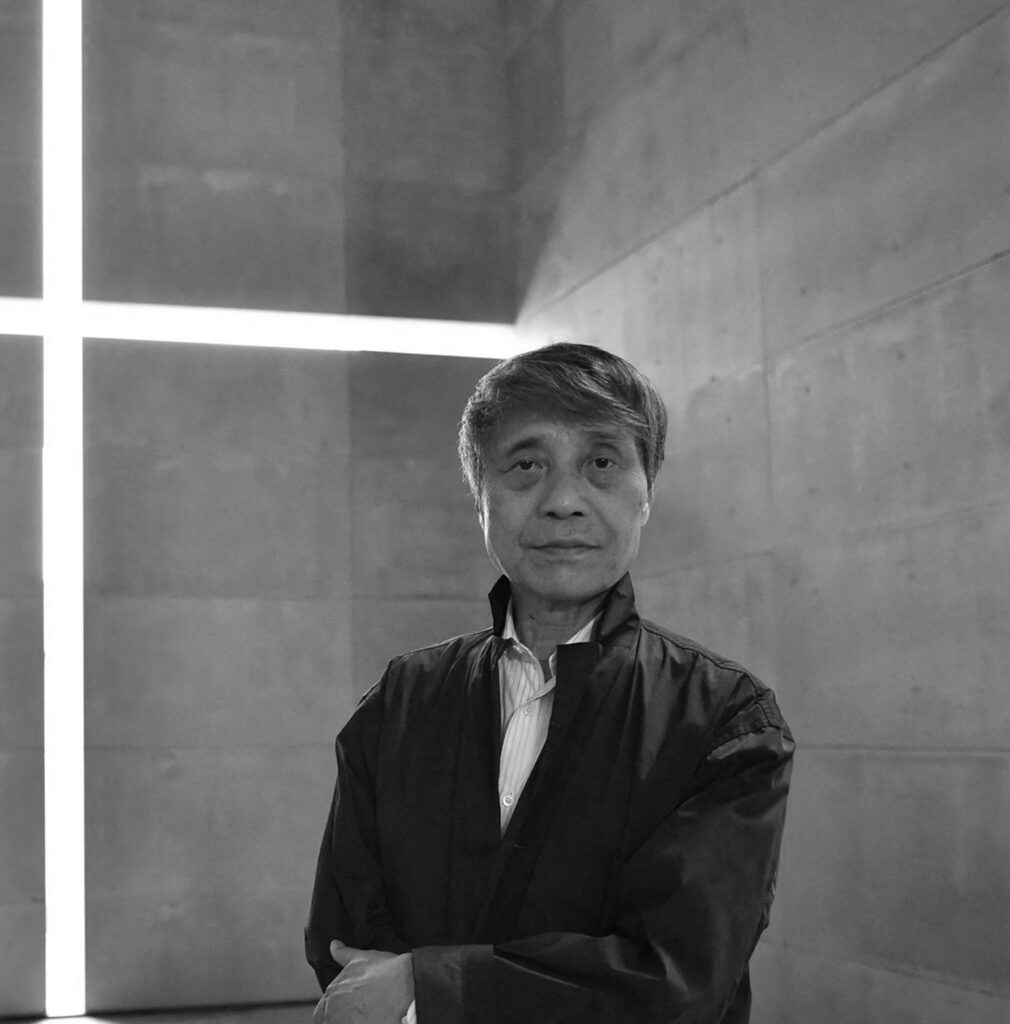
Tadao Ando (born 1941) is a self-taught Japanese architect and winner of the 1995 Pritzker Architecture Prize, renowned for his mastery of light, space, and cast-in-place concrete. Originally a professional boxer and truck driver, Ando chose to pursue architecture by visiting iconic buildings across Europe, Africa, and the United States, developing a philosophy deeply rooted in Zen Buddhist concepts of simplicity and the “haiku” effect. His work is characterized by the use of smooth, silk-like concrete—often marked by the visible holes of formwork ties—and a commitment to “critical regionalism,” which seeks to balance global modernism with the specific cultural and natural geography of a site.
Ando’s architectural language frequently employs geometric forms that define and enclose space, creating a physical boundary between the chaotic urban environment and a tranquil interior. Notable examples of this approach include the Church of the Light (1989) in Osaka, where a cruciform opening in a concrete wall allows light to define the spiritual space, and the Chichu Art Museum (2004) in Naoshima, which is built entirely underground to preserve the natural landscape of the Seto Inland Sea. His designs often incorporate natural elements like water and wind, treating them as structural components that change the character of the building throughout the day.
Over a career spanning more than five decades, Ando has completed major international commissions, including the Modern Art Museum of Fort Worth, the Punta della Dogana in Venice, and the Bourse de Commerce in Paris. His influence extends beyond physical structures through his advocacy for environmental reforestation and his role as a professor emeritus at the University of Tokyo. Recognized with the AIA Gold Medal and the Kyoto Prize, Ando’s work remains a benchmark for contemporary minimalism, celebrated for its ability to evoke profound emotional and spiritual responses through the sophisticated manipulation of void and materiality.
ARTWORK
ARTWORK
ARTWORK