ROBERT MORRIS
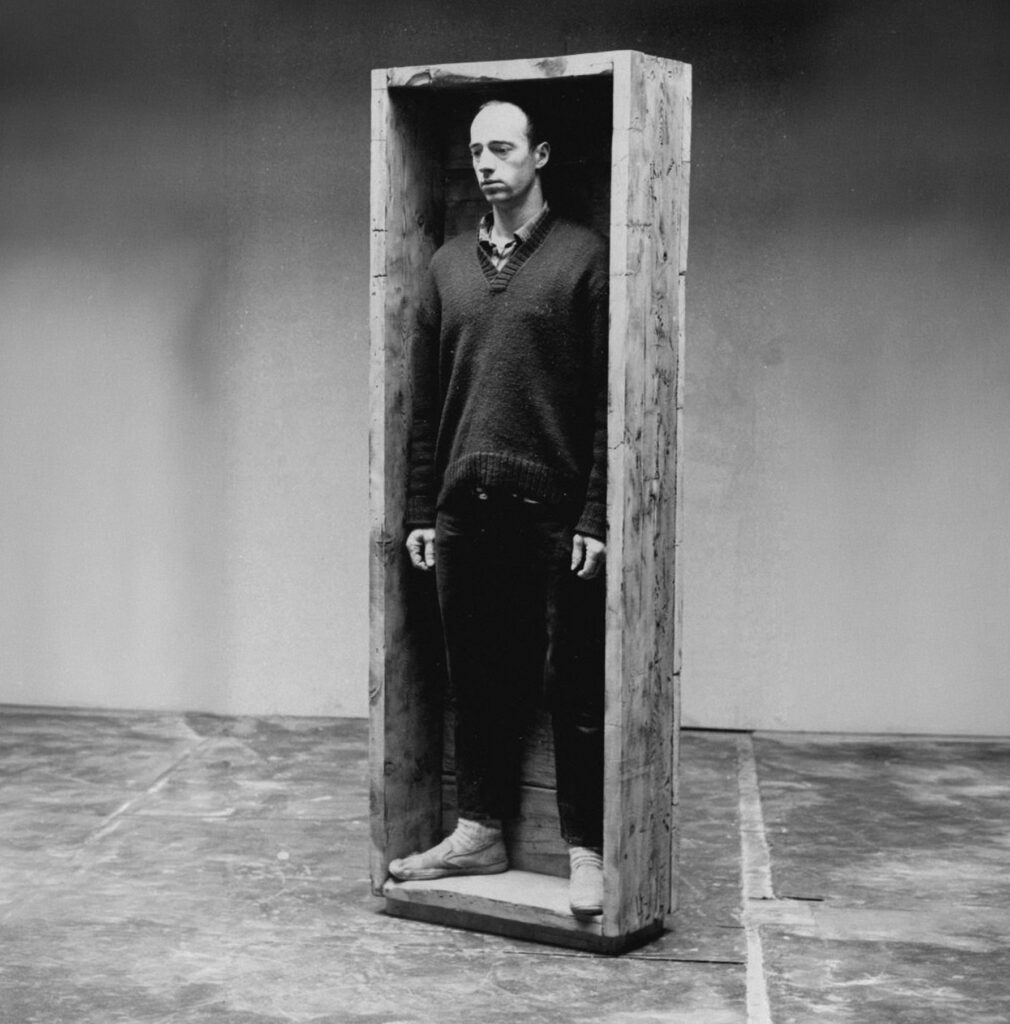
Robert Morris (1931–2018) was a foundational American artist and theorist whose work helped define several major movements of the late 20th century, including Minimalism, Process Art, and Land Art. After studying at the University of Kansas and Reed College, Morris moved to New York in the late 1950s, where he became a key figure in the Judson Dance Theater. This background in choreography heavily influenced his approach to sculpture, leading him to view the art object not as a static entity, but as something defined by the viewer's physical movement and the surrounding architectural environment. His early "Grey Plywood" sculptures utilized simple geometric forms to emphasize the phenomenological experience of space.
In the late 1960s, Morris transitioned away from the rigid structures of Minimalism toward "Anti-Form" and Process Art. He famously utilized industrial materials like felt, which he allowed to hang and drape according to the laws of gravity, arguing that the properties of the material and the process of making should dictate the final form of the work. This period also saw his involvement in large-scale earthworks, such as the Observatory (1971) in the Netherlands, which aligned his practice with the burgeoning Land Art movement. His theoretical writings, particularly the "Notes on Sculpture" series published in Artforum, provided a critical framework for understanding how sculpture could occupy a "literal" space rather than a representational one.
Robert Morris (1931–2018) was a foundational American artist and theorist whose work helped define several major movements of the late 20th century, including Minimalism, Process Art, and Land Art. After studying at the University of Kansas and Reed College, Morris moved to New York in the late 1950s, where he became a key figure in the Judson Dance Theater. This background in choreography heavily influenced his approach to sculpture, leading him to view the art object not as a static entity, but as something defined by the viewer's physical movement and the surrounding architectural environment. His early "Grey Plywood" sculptures utilized simple geometric forms to emphasize the phenomenological experience of space.
In the late 1960s, Morris transitioned away from the rigid structures of Minimalism toward "Anti-Form" and Process Art. He famously utilized industrial materials like felt, which he allowed to hang and drape according to the laws of gravity, arguing that the properties of the material and the process of making should dictate the final form of the work. This period also saw his involvement in large-scale earthworks, such as the Observatory (1971) in the Netherlands, which aligned his practice with the burgeoning Land Art movement. His theoretical writings, particularly the "Notes on Sculpture" series published in Artforum, provided a critical framework for understanding how sculpture could occupy a "literal" space rather than a representational one.
Throughout his prolific career, Morris’s work remained marked by a constant evolution and a willingness to engage with diverse media, including performance, film, and installation. In the 1980s, he surprised the art world by returning to more figurative and expressive themes, often exploring grim or apocalyptic subjects in his Hydrocal reliefs. Despite these shifts in style, his practice remained anchored in an investigation of the body's relationship to its environment and the psychological impact of scale. Morris was the subject of numerous retrospectives, most notably at the Solomon R. Guggenheim Museum and the Whitney Museum of American Art, and his influence persists as a central pillar of contemporary art history.
ROBERT MORRIS
Robert Morris (1931–2018) was a foundational American artist and theorist whose work helped define several major movements of the late 20th century, including Minimalism, Process Art, and Land Art. After studying at the University of Kansas and Reed College, Morris moved to New York in the late 1950s...
Robert Morris (1931–2018) was a foundational American artist and theorist whose work helped define several major movements of the late 20th century, including Minimalism, Process Art, and Land Art. After studying at the University of Kansas and Reed College, Morris moved to New York in the late 1950s, where he became a key figure in the Judson Dance Theater. This background in choreography heavily influenced his approach to sculpture, leading him to view the art object not as a static entity, but as something defined by the viewer's physical movement and the surrounding architectural environment. His early "Grey Plywood" sculptures utilized simple geometric forms to emphasize the phenomenological experience of space.
In the late 1960s, Morris transitioned away from the rigid structures of Minimalism toward "Anti-Form" and Process Art. He famously utilized industrial materials like felt, which he allowed to hang and drape according to the laws of gravity, arguing that the properties of the material and the process of making should dictate the final form of the work. This period also saw his involvement in large-scale earthworks, such as the Observatory (1971) in the Netherlands, which aligned his practice with the burgeoning Land Art movement. His theoretical writings, particularly the "Notes on Sculpture" series published in Artforum, provided a critical framework for understanding how sculpture could occupy a "literal" space rather than a representational one.
Throughout his prolific career, Morris’s work remained marked by a constant evolution and a willingness to engage with diverse media, including performance, film, and installation. In the 1980s, he surprised the art world by returning to more figurative and expressive themes, often exploring grim or apocalyptic subjects in his Hydrocal reliefs. Despite these shifts in style, his practice remained anchored in an investigation of the body's relationship to its environment and the psychological impact of scale. Morris was the subject of numerous retrospectives, most notably at the Solomon R. Guggenheim Museum and the Whitney Museum of American Art, and his influence persists as a central pillar of contemporary art history.
ROBERT MORRIS
Robert Morris (1931–2018) was a foundational American artist and theorist whose work helped define several major movements of the late 20th century, including Minimalism, Process Art, and Land Art. After studying at the University of Kansas and Reed College, Morris moved to New York in the late 1950s, where he became a key figure in the Judson Dance Theater. This background in choreography heavily influenced his approach to sculpture, leading him to view the art object not as a static entity, but as something defined by the viewer’s physical movement and the surrounding architectural environment. His early “Grey Plywood” sculptures utilized simple geometric forms to emphasize the phenomenological experience of space.
In the late 1960s, Morris transitioned away from the rigid structures of Minimalism toward “Anti-Form” and Process Art. He famously utilized industrial materials like felt, which he allowed to hang and drape according to the laws of gravity, arguing that the properties of the material and the process of making should dictate the final form of the work. This period also saw his involvement in large-scale earthworks, such as the Observatory (1971) in the Netherlands, which aligned his practice with the burgeoning Land Art movement. His theoretical writings, particularly the “Notes on Sculpture” series published in Artforum, provided a critical framework for understanding how sculpture could occupy a “literal” space rather than a representational one.
Throughout his prolific career, Morris’s work remained marked by a constant evolution and a willingness to engage with diverse media, including performance, film, and installation. In the 1980s, he surprised the art world by returning to more figurative and expressive themes, often exploring grim or apocalyptic subjects in his Hydrocal reliefs. Despite these shifts in style, his practice remained anchored in an investigation of the body’s relationship to its environment and the psychological impact of scale. Morris was the subject of numerous retrospectives, most notably at the Solomon R. Guggenheim Museum and the Whitney Museum of American Art, and his influence persists as a central pillar of contemporary art history.
ARTWORK
ARTWORK
ARTWORK
