
YOKO ONO
Yoko Ono (born 1933) is a Japanese multimedia artist, singer, songwriter, and peace activist whose work has been central to the development of conceptual art, performance art, and experimental film. Born into an aristocratic family in Tokyo, she moved to New York in the 1950s and became a key figure in the downtown avant-garde scene. In the early 1960s, she was closely associated with the Fluxus movement and gained recognition for her "instruction pieces," which invited viewers to complete the artwork through mental or physical actions. Her seminal book Grapefruit (1964) serves as a compilation of these instructions, emphasizing the idea of the artwork over its material form.
Ono’s practice is characterized by a minimalist aesthetic and a focus on themes of vulnerability, feminism, and global peace. One of her most influential performances, Cut Piece (1964), involved the artist sitting silently on a stage while audience members were invited to use scissors to cut away pieces of her clothing. This work explored the relationship between the artist and the observer, as well as the social implications of gender and passivity. Following her marriage to John Lennon in 1969, she utilized her public platform for high-profile peace activism, most notably through the Bed-In for Peace and the "War Is Over! (If You Want It)" billboard campaign, which integrated conceptual art strategies with mass media to promote social change.
Yoko Ono (born 1933) is a Japanese multimedia artist, singer, songwriter, and peace activist whose work has been central to the development of conceptual art, performance art, and experimental film. Born into an aristocratic family in Tokyo, she moved to New York in the 1950s and became a key figure in the downtown avant-garde scene. In the early 1960s, she was closely associated with the Fluxus movement and gained recognition for her "instruction pieces," which invited viewers to complete the artwork through mental or physical actions. Her seminal book Grapefruit (1964) serves as a compilation of these instructions, emphasizing the idea of the artwork over its material form.
Ono’s practice is characterized by a minimalist aesthetic and a focus on themes of vulnerability, feminism, and global peace. One of her most influential performances, Cut Piece (1964), involved the artist sitting silently on a stage while audience members were invited to use scissors to cut away pieces of her clothing. This work explored the relationship between the artist and the observer, as well as the social implications of gender and passivity. Following her marriage to John Lennon in 1969, she utilized her public platform for high-profile peace activism, most notably through the Bed-In for Peace and the "War Is Over! (If You Want It)" billboard campaign, which integrated conceptual art strategies with mass media to promote social change.
Throughout her career, Ono has continued to produce work across various media, including music, sculpture, and large-scale public installations. Her Wish Tree project, initiated in the 1980s, has seen thousands of trees planted globally, inviting participants to tie written wishes to their branches. Despite facing significant public scrutiny throughout her life, her artistic contributions have been increasingly recognized by major institutions, leading to retrospectives at the Museum of Modern Art in New York and the Tate Modern in London. In 2009, she was awarded the Golden Lion for Lifetime Achievement at the Venice Biennale, cementing her legacy as a pioneer who challenged the boundaries between art, life, and political discourse.
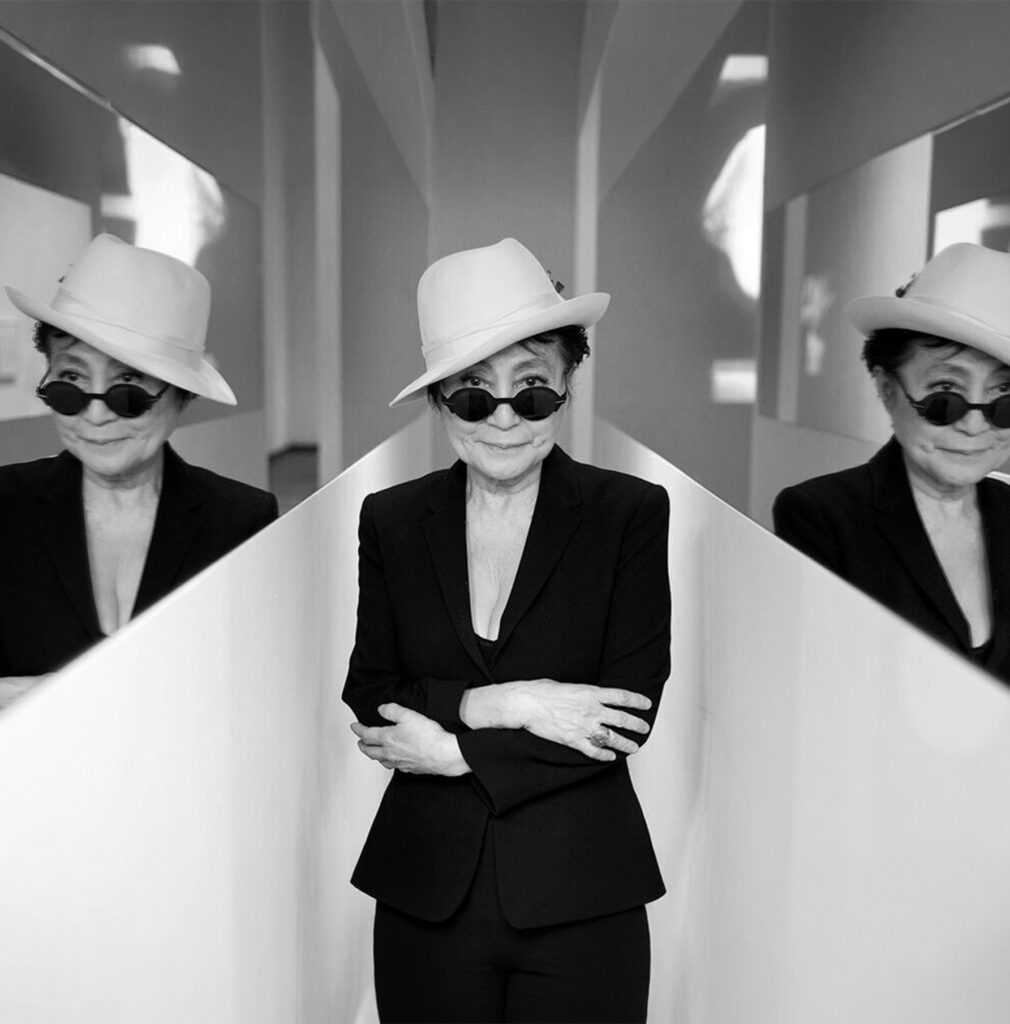
YOKO ONO
Yoko Ono (born 1933) is a Japanese multimedia artist, singer, songwriter, and peace activist whose work has been central to the development of conceptual art, performance art, and experimental film. Born into an aristocratic family in Tokyo, she moved to New York in the 1950s and became a key figure in the...
Yoko Ono (born 1933) is a Japanese multimedia artist, singer, songwriter, and peace activist whose work has been central to the development of conceptual art, performance art, and experimental film. Born into an aristocratic family in Tokyo, she moved to New York in the 1950s and became a key figure in the downtown avant-garde scene. In the early 1960s, she was closely associated with the Fluxus movement and gained recognition for her "instruction pieces," which invited viewers to complete the artwork through mental or physical actions. Her seminal book Grapefruit (1964) serves as a compilation of these instructions, emphasizing the idea of the artwork over its material form.
Ono’s practice is characterized by a minimalist aesthetic and a focus on themes of vulnerability, feminism, and global peace. One of her most influential performances, Cut Piece (1964), involved the artist sitting silently on a stage while audience members were invited to use scissors to cut away pieces of her clothing. This work explored the relationship between the artist and the observer, as well as the social implications of gender and passivity. Following her marriage to John Lennon in 1969, she utilized her public platform for high-profile peace activism, most notably through the Bed-In for Peace and the "War Is Over! (If You Want It)" billboard campaign, which integrated conceptual art strategies with mass media to promote social change.
Throughout her career, Ono has continued to produce work across various media, including music, sculpture, and large-scale public installations. Her Wish Tree project, initiated in the 1980s, has seen thousands of trees planted globally, inviting participants to tie written wishes to their branches. Despite facing significant public scrutiny throughout her life, her artistic contributions have been increasingly recognized by major institutions, leading to retrospectives at the Museum of Modern Art in New York and the Tate Modern in London. In 2009, she was awarded the Golden Lion for Lifetime Achievement at the Venice Biennale, cementing her legacy as a pioneer who challenged the boundaries between art, life, and political discourse.
YOKO ONO
Yoko Ono (born 1933) is a Japanese multimedia artist, singer, songwriter, and peace activist whose work has been central to the development of conceptual art, performance art, and experimental film. Born into an aristocratic family in Tokyo, she moved to New York in the 1950s and became a key figure in the downtown avant-garde scene. In the early 1960s, she was closely associated with the Fluxus movement and gained recognition for her “instruction pieces,” which invited viewers to complete the artwork through mental or physical actions. Her seminal book Grapefruit (1964) serves as a compilation of these instructions, emphasizing the idea of the artwork over its material form.
Ono’s practice is characterized by a minimalist aesthetic and a focus on themes of vulnerability, feminism, and global peace. One of her most influential performances, Cut Piece (1964), involved the artist sitting silently on a stage while audience members were invited to use scissors to cut away pieces of her clothing. This work explored the relationship between the artist and the observer, as well as the social implications of gender and passivity. Following her marriage to John Lennon in 1969, she utilized her public platform for high-profile peace activism, most notably through the Bed-In for Peace and the “War Is Over! (If You Want It)” billboard campaign, which integrated conceptual art strategies with mass media to promote social change.
Throughout her career, Ono has continued to produce work across various media, including music, sculpture, and large-scale public installations. Her Wish Tree project, initiated in the 1980s, has seen thousands of trees planted globally, inviting participants to tie written wishes to their branches. Despite facing significant public scrutiny throughout her life, her artistic contributions have been increasingly recognized by major institutions, leading to retrospectives at the Museum of Modern Art in New York and the Tate Modern in London. In 2009, she was awarded the Golden Lion for Lifetime Achievement at the Venice Biennale, cementing her legacy as a pioneer who challenged the boundaries between art, life, and political discourse.
ARTWORK
ARTWORK
ARTWORK
