
ROSE B. SIMPSON
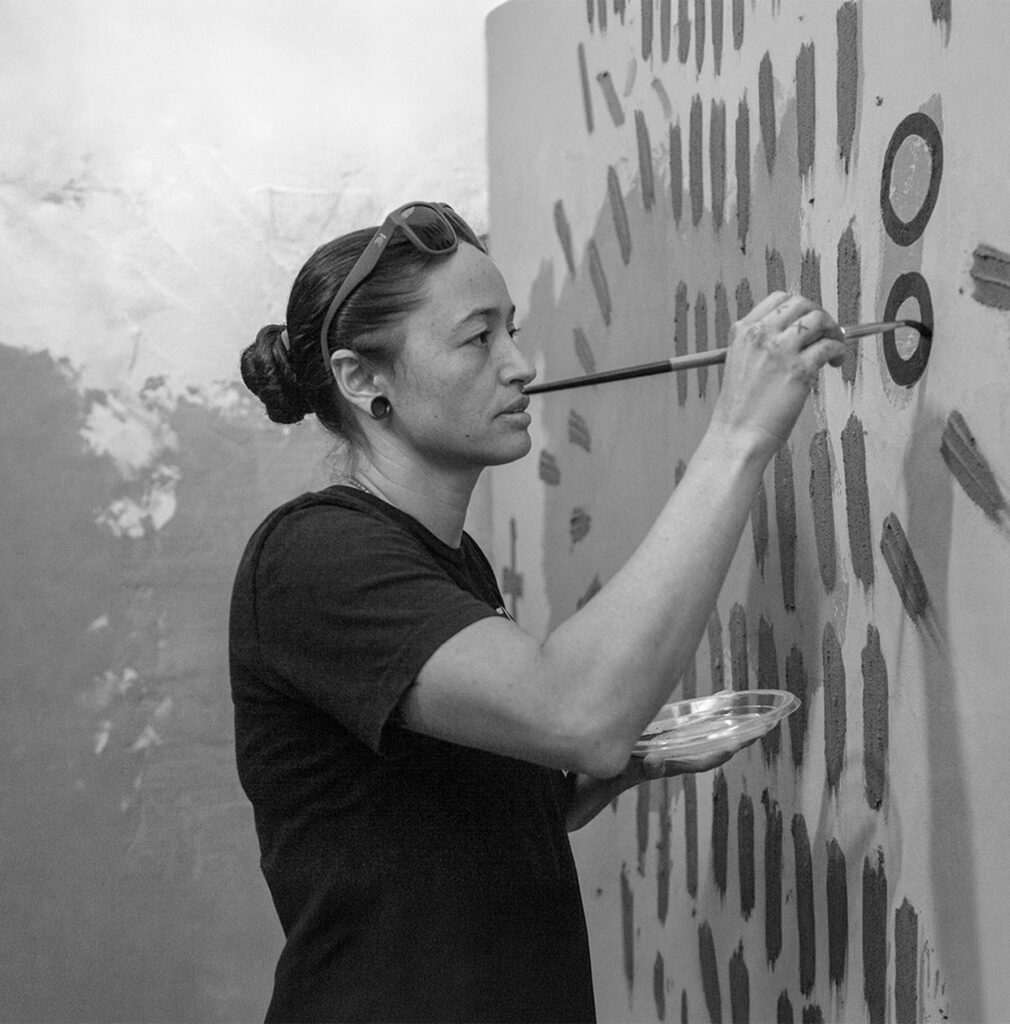
Rose B. Simpson (born 1983) is a contemporary mixed-media artist from Santa Clara Pueblo, New Mexico, known for a practice that bridges ancestral Tewa pottery traditions with contemporary sociological themes. The daughter of prominent ceramicist Roxanne Swentzell, Simpson earned an MFA in Ceramics from the Rhode Island School of Design and an MFA in Creative Writing from the Institute of American Indian Arts. Her work primarily centers on "androgynous" clay figures that serve as vessels for exploring themes of protection, resilience, and the internal human condition. These sculptures often incorporate diverse materials such as steel, wood, leather, and found objects, reflecting a philosophy she calls "slap-back"—a creative response to the external pressures of modern life.
Simpson’s artistic reach extends beyond ceramics into performance, installation, and automotive design. A notable example of her multidisciplinary approach is Maria (2014), a 1985 Chevrolet El Camino that she customized with black-on-black matte designs in tribute to the legendary San Ildefonso Pueblo potter Maria Martinez. This project highlights her interest in "Tribal Futurism" and the intersection of traditional Indigenous aesthetics with industrial subcultures. Her large-scale public installations, such as the towering figures exhibited at the Field Museum in Chicago and Madison Square Park in New York, utilize the human form to initiate a dialogue between the viewer and the landscape, often emphasizing a sense of ancestral presence within...
Rose B. Simpson (born 1983) is a contemporary mixed-media artist from Santa Clara Pueblo, New Mexico, known for a practice that bridges ancestral Tewa pottery traditions with contemporary sociological themes. The daughter of prominent ceramicist Roxanne Swentzell, Simpson earned an MFA in Ceramics from the Rhode Island School of Design and an MFA in Creative Writing from the Institute of American Indian Arts. Her work primarily centers on "androgynous" clay figures that serve as vessels for exploring themes of protection, resilience, and the internal human condition. These sculptures often incorporate diverse materials such as steel, wood, leather, and found objects, reflecting a philosophy she calls "slap-back"—a creative response to the external pressures of modern life.
Simpson’s artistic reach extends beyond ceramics into performance, installation, and automotive design. A notable example of her multidisciplinary approach is Maria (2014), a 1985 Chevrolet El Camino that she customized with black-on-black matte designs in tribute to the legendary San Ildefonso Pueblo potter Maria Martinez. This project highlights her interest in "Tribal Futurism" and the intersection of traditional Indigenous aesthetics with industrial subcultures. Her large-scale public installations, such as the towering figures exhibited at the Field Museum in Chicago and Madison Square Park in New York, utilize the human form to initiate a dialogue between the viewer and the landscape, often emphasizing a sense of ancestral presence within modern civic spaces.
Throughout her career, Simpson has received significant critical acclaim and has been featured in major exhibitions at institutions including the Whitney Museum of American Art, the San Francisco Museum of Modern Art, and the Denver Art Museum. Her work is characterized by a deliberate rejection of Western colonial gaze, focusing instead on the spiritual and psychological utility of art as a tool for personal and communal healing. In 2026, she continues to live and work at Santa Clara Pueblo, maintaining a practice that honors her cultural heritage while actively participating in the global contemporary art discourse.
ROSE B. SIMPSON
Rose B. Simpson (born 1983) is a contemporary mixed-media artist from Santa Clara Pueblo, New Mexico, known for a practice that bridges ancestral Tewa pottery traditions with contemporary sociological themes. The daughter of...
Rose B. Simpson (born 1983) is a contemporary mixed-media artist from Santa Clara Pueblo, New Mexico, known for a practice that bridges ancestral Tewa pottery traditions with contemporary sociological themes. The daughter of prominent ceramicist Roxanne Swentzell, Simpson earned an MFA in Ceramics from the Rhode Island School of Design and an MFA in Creative Writing from the Institute of American Indian Arts. Her work primarily centers on "androgynous" clay figures that serve as vessels for exploring themes of protection, resilience, and the internal human condition. These sculptures often incorporate diverse materials such as steel, wood, leather, and found objects, reflecting a philosophy she calls "slap-back"—a creative response to the external pressures of modern life.
Simpson’s artistic reach extends beyond ceramics into performance, installation, and automotive design. A notable example of her multidisciplinary approach is Maria (2014), a 1985 Chevrolet El Camino that she customized with black-on-black matte designs in tribute to the legendary San Ildefonso Pueblo potter Maria Martinez. This project highlights her interest in "Tribal Futurism" and the intersection of traditional Indigenous aesthetics with industrial subcultures. Her large-scale public installations, such as the towering figures exhibited at the Field Museum in Chicago and Madison Square Park in New York, utilize the human form to initiate a dialogue between the viewer and the landscape, often emphasizing a sense of ancestral presence within modern civic spaces.
Throughout her career, Simpson has received significant critical acclaim and has been featured in major exhibitions at institutions including the Whitney Museum of American Art, the San Francisco Museum of Modern Art, and the Denver Art Museum. Her work is characterized by a deliberate rejection of Western colonial gaze, focusing instead on the spiritual and psychological utility of art as a tool for personal and communal healing. In 2026, she continues to live and work at Santa Clara Pueblo, maintaining a practice that honors her cultural heritage while actively participating in the global contemporary art discourse.
ROSE B. SIMPSON
Rose B. Simpson (born 1983) is a contemporary mixed-media artist from Santa Clara Pueblo, New Mexico, known for a practice that bridges ancestral Tewa pottery traditions with contemporary sociological themes. The daughter of prominent ceramicist Roxanne Swentzell, Simpson earned an MFA in Ceramics from the Rhode Island School of Design and an MFA in Creative Writing from the Institute of American Indian Arts. Her work primarily centers on “androgynous” clay figures that serve as vessels for exploring themes of protection, resilience, and the internal human condition. These sculptures often incorporate diverse materials such as steel, wood, leather, and found objects, reflecting a philosophy she calls “slap-back”—a creative response to the external pressures of modern life.
Simpson’s artistic reach extends beyond ceramics into performance, installation, and automotive design. A notable example of her multidisciplinary approach is Maria (2014), a 1985 Chevrolet El Camino that she customized with black-on-black matte designs in tribute to the legendary San Ildefonso Pueblo potter Maria Martinez. This project highlights her interest in “Tribal Futurism” and the intersection of traditional Indigenous aesthetics with industrial subcultures. Her large-scale public installations, such as the towering figures exhibited at the Field Museum in Chicago and Madison Square Park in New York, utilize the human form to initiate a dialogue between the viewer and the landscape, often emphasizing a sense of ancestral presence within modern civic spaces.
Throughout her career, Simpson has received significant critical acclaim and has been featured in major exhibitions at institutions including the Whitney Museum of American Art, the San Francisco Museum of Modern Art, and the Denver Art Museum. Her work is characterized by a deliberate rejection of Western colonial gaze, focusing instead on the spiritual and psychological utility of art as a tool for personal and communal healing. In 2026, she continues to live and work at Santa Clara Pueblo, maintaining a practice that honors her cultural heritage while actively participating in the global contemporary art discourse.
ARTWORK
ARTWORK
ARTWORK


