
NAM JUNE PAIK
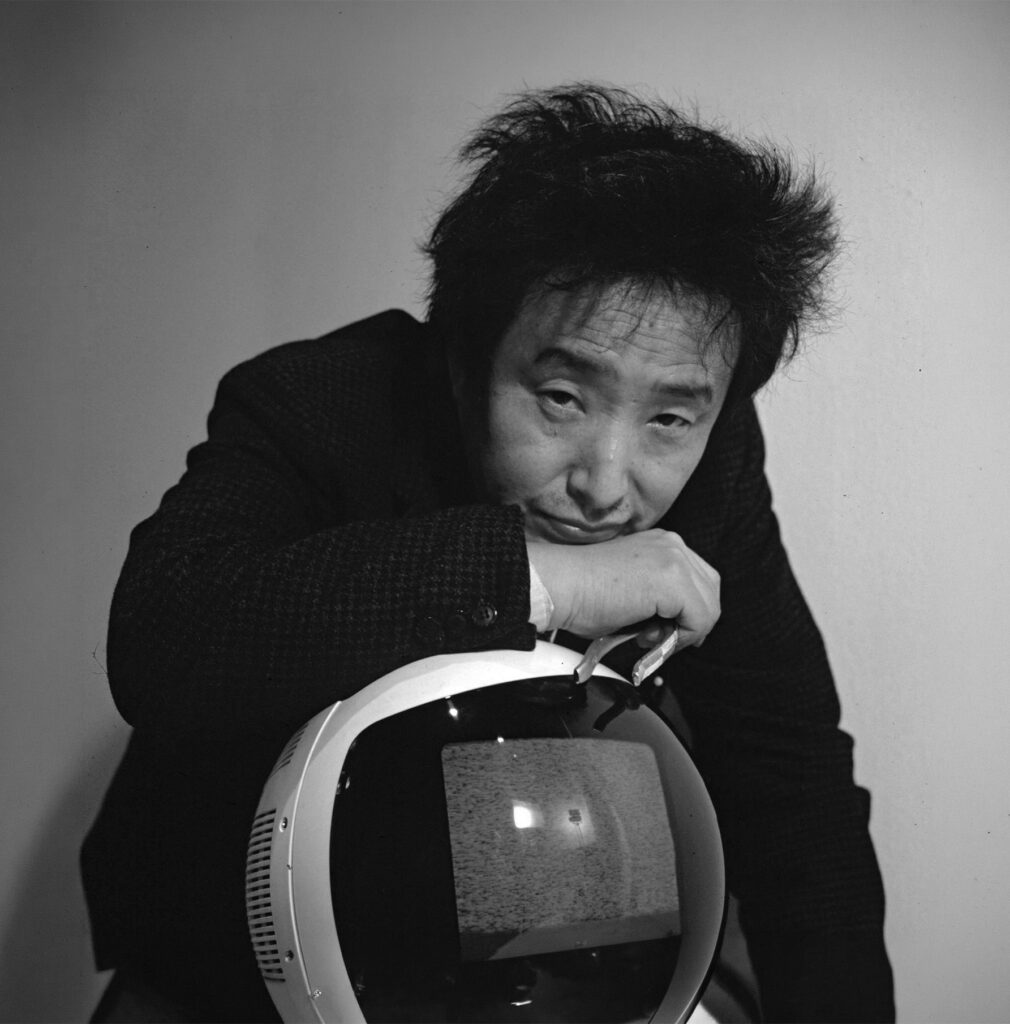
Nam June Paik (1932–2006) was a South Korean-born American artist widely regarded as the "father of video art." Originally trained as a classical pianist and composer in Tokyo and Munich, Paik’s career was defined by his move toward the avant-garde after meeting composer John Cage and becoming a core member of the Fluxus movement in the 1960s. He shifted his focus from music to the electronic image, famously premiering some of the first examples of video art by using magnets to distort television broadcasts. His practice was characterized by a playful yet profound engagement with technology, aimed at humanizing the "electronic superhighway"—a term he is credited with coining to describe a future of interconnected global communication.
Paik’s body of work is noted for its monumental scale and its integration of various media, including television sets, neon lights, and live performance. Among his most iconic works is TV Buddha (1974), which features a 18th-century bronze Buddha statue watching its own live-streamed image on a monitor, reflecting on the relationship between ancient spirituality and modern technology. His large-scale installations, such as The More the Better (1988), composed of 1,003 monitors, and his collaborative performances with cellist Charlotte Moorman, pushed the boundaries of what could be considered fine art. By treating the television as a sculptural object rather than just a medium for information, Paik transformed the domestic appliance into a site for...
Nam June Paik (1932–2006) was a South Korean-born American artist widely regarded as the "father of video art." Originally trained as a classical pianist and composer in Tokyo and Munich, Paik’s career was defined by his move toward the avant-garde after meeting composer John Cage and becoming a core member of the Fluxus movement in the 1960s. He shifted his focus from music to the electronic image, famously premiering some of the first examples of video art by using magnets to distort television broadcasts. His practice was characterized by a playful yet profound engagement with technology, aimed at humanizing the "electronic superhighway"—a term he is credited with coining to describe a future of interconnected global communication.
Paik’s body of work is noted for its monumental scale and its integration of various media, including television sets, neon lights, and live performance. Among his most iconic works is TV Buddha (1974), which features a 18th-century bronze Buddha statue watching its own live-streamed image on a monitor, reflecting on the relationship between ancient spirituality and modern technology. His large-scale installations, such as The More the Better (1988), composed of 1,003 monitors, and his collaborative performances with cellist Charlotte Moorman, pushed the boundaries of what could be considered fine art. By treating the television as a sculptural object rather than just a medium for information, Paik transformed the domestic appliance into a site for creative and philosophical exploration.
Throughout his career, Paik received numerous prestigious awards, including the Picasso Medal and the Kyoto Prize. His influence extends beyond the gallery space, impacting the development of music videos, digital art, and contemporary broadcasting. His works are held in the permanent collections of major global institutions, including the Guggenheim Museum, the Whitney Museum of American Art, and the National Museum of Modern and Contemporary Art in Korea. Today, Paik is remembered not only for his technical innovations but for his visionary understanding of how technology would eventually shape the social and cultural fabric of the 21st century.
NAM JUNE PAIK
Nam June Paik (1932–2006) was a South Korean-born American artist widely regarded as the "father of video art." Originally trained as a classical pianist and composer in Tokyo and Munich, Paik’s career was defined by his move toward the avant-garde after meeting composer John Cage and becoming a core...
Nam June Paik (1932–2006) was a South Korean-born American artist widely regarded as the "father of video art." Originally trained as a classical pianist and composer in Tokyo and Munich, Paik’s career was defined by his move toward the avant-garde after meeting composer John Cage and becoming a core member of the Fluxus movement in the 1960s. He shifted his focus from music to the electronic image, famously premiering some of the first examples of video art by using magnets to distort television broadcasts. His practice was characterized by a playful yet profound engagement with technology, aimed at humanizing the "electronic superhighway"—a term he is credited with coining to describe a future of interconnected global communication.
Paik’s body of work is noted for its monumental scale and its integration of various media, including television sets, neon lights, and live performance. Among his most iconic works is TV Buddha (1974), which features a 18th-century bronze Buddha statue watching its own live-streamed image on a monitor, reflecting on the relationship between ancient spirituality and modern technology. His large-scale installations, such as The More the Better (1988), composed of 1,003 monitors, and his collaborative performances with cellist Charlotte Moorman, pushed the boundaries of what could be considered fine art. By treating the television as a sculptural object rather than just a medium for information, Paik transformed the domestic appliance into a site for creative and philosophical exploration.
Throughout his career, Paik received numerous prestigious awards, including the Picasso Medal and the Kyoto Prize. His influence extends beyond the gallery space, impacting the development of music videos, digital art, and contemporary broadcasting. His works are held in the permanent collections of major global institutions, including the Guggenheim Museum, the Whitney Museum of American Art, and the National Museum of Modern and Contemporary Art in Korea. Today, Paik is remembered not only for his technical innovations but for his visionary understanding of how technology would eventually shape the social and cultural fabric of the 21st century.
NAM JUNE PAIK
Nam June Paik (1932–2006) was a South Korean-born American artist widely regarded as the “father of video art.” Originally trained as a classical pianist and composer in Tokyo and Munich, Paik’s career was defined by his move toward the avant-garde after meeting composer John Cage and becoming a core member of the Fluxus movement in the 1960s. He shifted his focus from music to the electronic image, famously premiering some of the first examples of video art by using magnets to distort television broadcasts. His practice was characterized by a playful yet profound engagement with technology, aimed at humanizing the “electronic superhighway”—a term he is credited with coining to describe a future of interconnected global communication.
Paik’s body of work is noted for its monumental scale and its integration of various media, including television sets, neon lights, and live performance. Among his most iconic works is TV Buddha (1974), which features a 18th-century bronze Buddha statue watching its own live-streamed image on a monitor, reflecting on the relationship between ancient spirituality and modern technology. His large-scale installations, such as The More the Better (1988), composed of 1,003 monitors, and his collaborative performances with cellist Charlotte Moorman, pushed the boundaries of what could be considered fine art. By treating the television as a sculptural object rather than just a medium for information, Paik transformed the domestic appliance into a site for creative and philosophical exploration.
Throughout his career, Paik received numerous prestigious awards, including the Picasso Medal and the Kyoto Prize. His influence extends beyond the gallery space, impacting the development of music videos, digital art, and contemporary broadcasting. His works are held in the permanent collections of major global institutions, including the Guggenheim Museum, the Whitney Museum of American Art, and the National Museum of Modern and Contemporary Art in Korea. Today, Paik is remembered not only for his technical innovations but for his visionary understanding of how technology would eventually shape the social and cultural fabric of the 21st century.