Robert Barry
Robert Barry (born 1936) is an American artist and a central figure in the development of Conceptual Art in the late 1960s. After studying at Hunter College under artists like Robert Motherwell, Barry began his career as a painter associated with Minimalism, producing monochromatic works that explored the edge of the canvas. However, by 1967, he abandoned traditional media to focus on the "unseen," utilizing non-material substances such as electromagnetic energy, ultrasonic sound, and inert gases. His practice shifted the emphasis from the physical art object to the ideas and environmental conditions surrounding its presentation.
Throughout the late 1960s, Barry executed several influential projects that challenged the limits of perception and the institutional space of the gallery. For his Inert Gas Series (1969), he released specific quantities of helium, neon, and argon into various outdoor environments, documenting the act rather than the invisible result. Another seminal work, Closed Gallery (1969), consisted of three exhibitions in Los Angeles, Amsterdam, and Turin where the galleries remained locked for the duration of the show, with a notice on the door informing visitors that the gallery was closed. These works explored the concept of "presence through absence" and the role of the viewer's expectation.
In the decades following his early conceptual experiments, Barry’s work evolved to incorporate language as a primary medium. He is well known for his "word-works,"...
Robert Barry (born 1936) is an American artist and a central figure in the development of Conceptual Art in the late 1960s. After studying at Hunter College under artists like Robert Motherwell, Barry began his career as a painter associated with Minimalism, producing monochromatic works that explored the edge of the canvas. However, by 1967, he abandoned traditional media to focus on the "unseen," utilizing non-material substances such as electromagnetic energy, ultrasonic sound, and inert gases. His practice shifted the emphasis from the physical art object to the ideas and environmental conditions surrounding its presentation.
Throughout the late 1960s, Barry executed several influential projects that challenged the limits of perception and the institutional space of the gallery. For his Inert Gas Series (1969), he released specific quantities of helium, neon, and argon into various outdoor environments, documenting the act rather than the invisible result. Another seminal work, Closed Gallery (1969), consisted of three exhibitions in Los Angeles, Amsterdam, and Turin where the galleries remained locked for the duration of the show, with a notice on the door informing visitors that the gallery was closed. These works explored the concept of "presence through absence" and the role of the viewer's expectation.
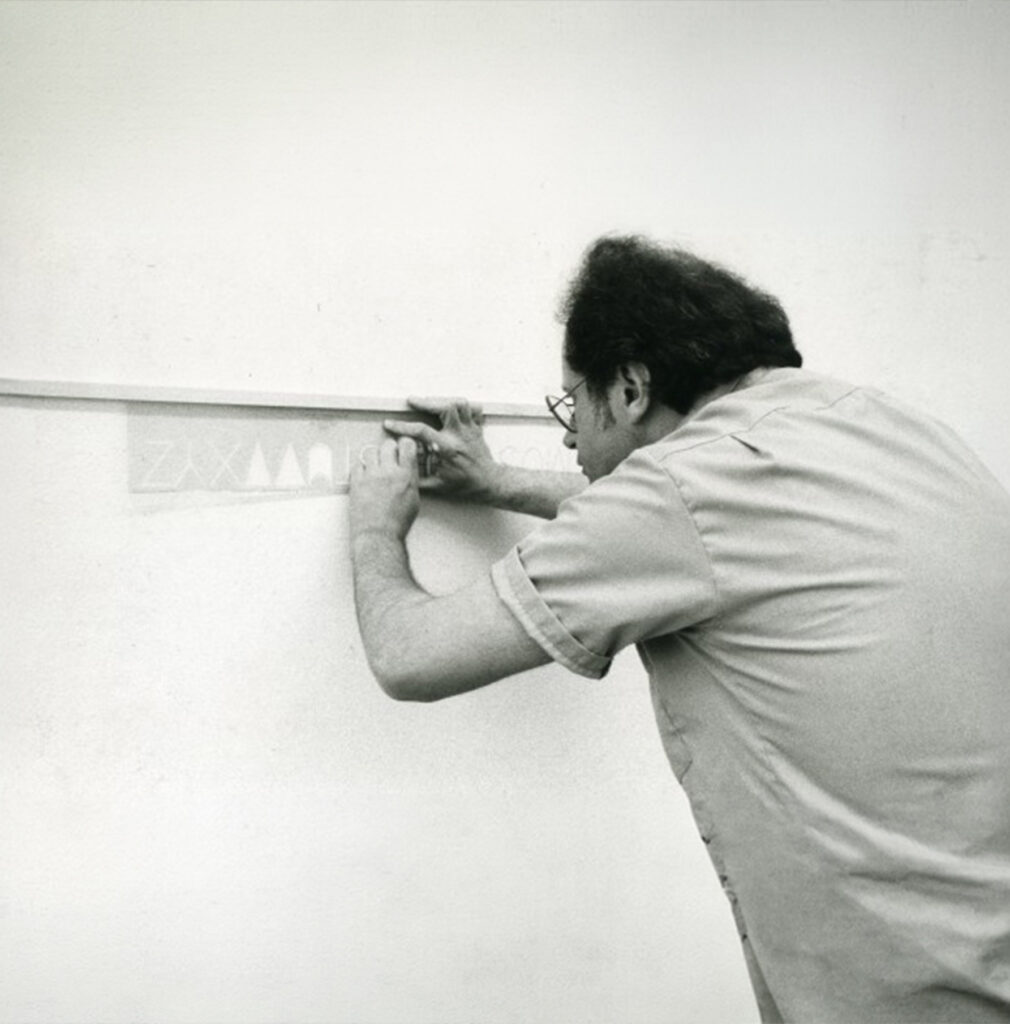
In the decades following his early conceptual experiments, Barry’s work evolved to incorporate language as a primary medium. He is well known for his "word-works," which involve applying evocative terms—such as "secret," "real," or "waiting"—directly onto gallery walls, floors, or glass surfaces in various fonts and arrangements. These installations encourage a psychological and spatial engagement, as the words often appear in corners or at architectural boundaries, forcing the viewer to navigate the space to read them. Barry's work has been exhibited at major institutions worldwide, including the Museum of Modern Art in New York and the Centre Pompidou in Paris, and he continues to investigate the intersection of language, space, and the void.
Robert Barry
Robert Barry (born 1936) is an American artist and a central figure in the development of Conceptual Art in the late 1960s. After studying at Hunter College under artists like Robert Motherwell, Barry began his career as a painter associated with Minimalism, producing monochromatic works that explored the...
Robert Barry (born 1936) is an American artist and a central figure in the development of Conceptual Art in the late 1960s. After studying at Hunter College under artists like Robert Motherwell, Barry began his career as a painter associated with Minimalism, producing monochromatic works that explored the edge of the canvas. However, by 1967, he abandoned traditional media to focus on the "unseen," utilizing non-material substances such as electromagnetic energy, ultrasonic sound, and inert gases. His practice shifted the emphasis from the physical art object to the ideas and environmental conditions surrounding its presentation.
Throughout the late 1960s, Barry executed several influential projects that challenged the limits of perception and the institutional space of the gallery. For his Inert Gas Series (1969), he released specific quantities of helium, neon, and argon into various outdoor environments, documenting the act rather than the invisible result. Another seminal work, Closed Gallery (1969), consisted of three exhibitions in Los Angeles, Amsterdam, and Turin where the galleries remained locked for the duration of the show, with a notice on the door informing visitors that the gallery was closed. These works explored the concept of "presence through absence" and the role of the viewer's expectation.
In the decades following his early conceptual experiments, Barry’s work evolved to incorporate language as a primary medium. He is well known for his "word-works," which involve applying evocative terms—such as "secret," "real," or "waiting"—directly onto gallery walls, floors, or glass surfaces in various fonts and arrangements. These installations encourage a psychological and spatial engagement, as the words often appear in corners or at architectural boundaries, forcing the viewer to navigate the space to read them. Barry's work has been exhibited at major institutions worldwide, including the Museum of Modern Art in New York and the Centre Pompidou in Paris, and he continues to investigate the intersection of language, space, and the void.
Robert Barry
Robert Barry (born 1936) is an American artist and a central figure in the development of Conceptual Art in the late 1960s. After studying at Hunter College under artists like Robert Motherwell, Barry began his career as a painter associated with Minimalism, producing monochromatic works that explored the edge of the canvas. However, by 1967, he abandoned traditional media to focus on the “unseen,” utilizing non-material substances such as electromagnetic energy, ultrasonic sound, and inert gases. His practice shifted the emphasis from the physical art object to the ideas and environmental conditions surrounding its presentation.
Throughout the late 1960s, Barry executed several influential projects that challenged the limits of perception and the institutional space of the gallery. For his Inert Gas Series (1969), he released specific quantities of helium, neon, and argon into various outdoor environments, documenting the act rather than the invisible result. Another seminal work, Closed Gallery (1969), consisted of three exhibitions in Los Angeles, Amsterdam, and Turin where the galleries remained locked for the duration of the show, with a notice on the door informing visitors that the gallery was closed. These works explored the concept of “presence through absence” and the role of the viewer’s expectation.
In the decades following his early conceptual experiments, Barry’s work evolved to incorporate language as a primary medium. He is well known for his “word-works,” which involve applying evocative terms—such as “secret,” “real,” or “waiting”—directly onto gallery walls, floors, or glass surfaces in various fonts and arrangements. These installations encourage a psychological and spatial engagement, as the words often appear in corners or at architectural boundaries, forcing the viewer to navigate the space to read them. Barry’s work has been exhibited at major institutions worldwide, including the Museum of Modern Art in New York and the Centre Pompidou in Paris, and he continues to investigate the intersection of language, space, and the void.
ARTWORK
ARTWORK
ARTWORK


