
SHIGEKO KUBOTA
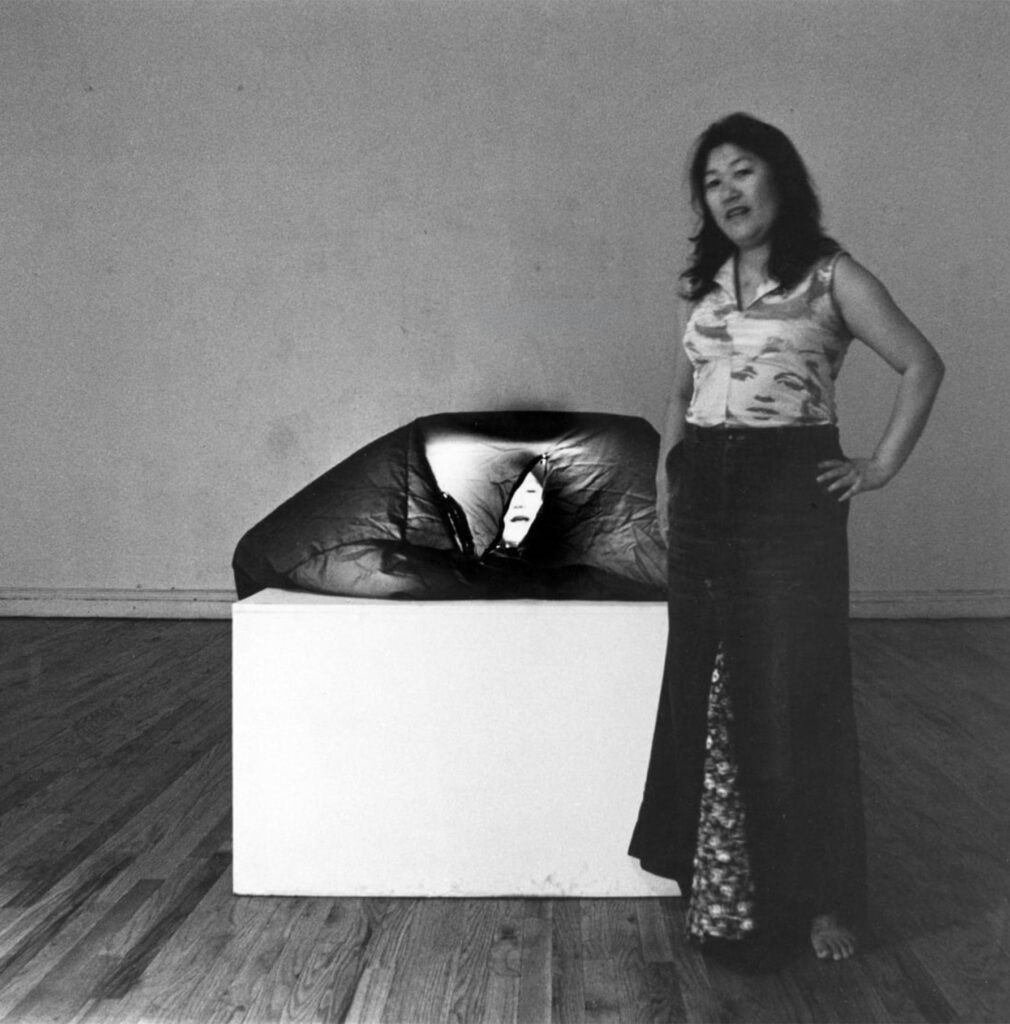
Shigeko Kubota (1937–2015) was a Japanese-born visual artist and a central figure in the development of video art and the Fluxus movement. After studying sculpture in Tokyo, Kubota moved to New York City in 1964 at the invitation of Fluxus founder George Maciunas. Her early work was characterized by a playful yet critical engagement with performance and feminism, most notably in Vagina Painting (1965), where she attached a brush to her underwear to create red gestural marks on floor-bound paper. This performance served as both a response to the male-dominated Abstract Expressionist movement and an assertion of the female body as a site of creative agency.
By the early 1970s, Kubota shifted her focus toward the emerging medium of portable video technology. She became a pioneer of the "video sculpture," a term she used to describe the integration of monitors and moving images into physical environments and three-dimensional forms. Her most acclaimed series, the Duchampiana sculptures (1976–1981), paid homage to Marcel Duchamp by reinterpreting his iconic modernist works through a digital lens. For example, in Duchampiana: Nude Descending a Staircase, she embedded video monitors into a plywood staircase, displaying a looped recording of a woman moving downward, thereby "sculpting" time and motion into a structural installation.
Shigeko Kubota (1937–2015) was a Japanese-born visual artist and a central figure in the development of video art and the Fluxus movement. After studying sculpture in Tokyo, Kubota moved to New York City in 1964 at the invitation of Fluxus founder George Maciunas. Her early work was characterized by a playful yet critical engagement with performance and feminism, most notably in Vagina Painting (1965), where she attached a brush to her underwear to create red gestural marks on floor-bound paper. This performance served as both a response to the male-dominated Abstract Expressionist movement and an assertion of the female body as a site of creative agency.
By the early 1970s, Kubota shifted her focus toward the emerging medium of portable video technology. She became a pioneer of the "video sculpture," a term she used to describe the integration of monitors and moving images into physical environments and three-dimensional forms. Her most acclaimed series, the Duchampiana sculptures (1976–1981), paid homage to Marcel Duchamp by reinterpreting his iconic modernist works through a digital lens. For example, in Duchampiana: Nude Descending a Staircase, she embedded video monitors into a plywood staircase, displaying a looped recording of a woman moving downward, thereby "sculpting" time and motion into a structural installation.
Throughout her career, Kubota served as the Video Curator at Anthology Film Archives and was a founding member of the Video Free America collective. Her practice remained deeply personal, often blending documentary footage of her travels and family—such as her relationship with her husband, Nam June Paik—with experimental electronic processing. Her work has been the subject of retrospectives at the Museum of Modern Art in New York and the Hara Museum of Contemporary Art in Tokyo. Kubota is remembered for her role in transitioning video from a broadcast medium into a formal sculptural element, bridging the gap between historical avant-garde traditions and the electronic age.
shigeko kubota
Shigeko Kubota (1937–2015) was a Japanese-born visual artist and a central figure in the development of video art and the Fluxus movement. After studying sculpture in Tokyo, Kubota moved to New York City in 1964 at the invitation of...
Shigeko Kubota (1937–2015) was a Japanese-born visual artist and a central figure in the development of video art and the Fluxus movement. After studying sculpture in Tokyo, Kubota moved to New York City in 1964 at the invitation of Fluxus founder George Maciunas. Her early work was characterized by a playful yet critical engagement with performance and feminism, most notably in Vagina Painting (1965), where she attached a brush to her underwear to create red gestural marks on floor-bound paper. This performance served as both a response to the male-dominated Abstract Expressionist movement and an assertion of the female body as a site of creative agency.
By the early 1970s, Kubota shifted her focus toward the emerging medium of portable video technology. She became a pioneer of the "video sculpture," a term she used to describe the integration of monitors and moving images into physical environments and three-dimensional forms. Her most acclaimed series, the Duchampiana sculptures (1976–1981), paid homage to Marcel Duchamp by reinterpreting his iconic modernist works through a digital lens. For example, in Duchampiana: Nude Descending a Staircase, she embedded video monitors into a plywood staircase, displaying a looped recording of a woman moving downward, thereby "sculpting" time and motion into a structural installation.
Throughout her career, Kubota served as the Video Curator at Anthology Film Archives and was a founding member of the Video Free America collective. Her practice remained deeply personal, often blending documentary footage of her travels and family—such as her relationship with her husband, Nam June Paik—with experimental electronic processing. Her work has been the subject of retrospectives at the Museum of Modern Art in New York and the Hara Museum of Contemporary Art in Tokyo. Kubota is remembered for her role in transitioning video from a broadcast medium into a formal sculptural element, bridging the gap between historical avant-garde traditions and the electronic age.
SHIGEKO KUBOTA
Shigeko Kubota (1937–2015) was a Japanese-born visual artist and a central figure in the development of video art and the Fluxus movement. After studying sculpture in Tokyo, Kubota moved to New York City in 1964 at the invitation of Fluxus founder George Maciunas. Her early work was characterized by a playful yet critical engagement with performance and feminism, most notably in Vagina Painting (1965), where she attached a brush to her underwear to create red gestural marks on floor-bound paper. This performance served as both a response to the male-dominated Abstract Expressionist movement and an assertion of the female body as a site of creative agency.
By the early 1970s, Kubota shifted her focus toward the emerging medium of portable video technology. She became a pioneer of the “video sculpture,” a term she used to describe the integration of monitors and moving images into physical environments and three-dimensional forms. Her most acclaimed series, the Duchampiana sculptures (1976–1981), paid homage to Marcel Duchamp by reinterpreting his iconic modernist works through a digital lens. For example, in Duchampiana: Nude Descending a Staircase, she embedded video monitors into a plywood staircase, displaying a looped recording of a woman moving downward, thereby “sculpting” time and motion into a structural installation.
Throughout her career, Kubota served as the Video Curator at Anthology Film Archives and was a founding member of the Video Free America collective. Her practice remained deeply personal, often blending documentary footage of her travels and family—such as her relationship with her husband, Nam June Paik—with experimental electronic processing. Her work has been the subject of retrospectives at the Museum of Modern Art in New York and the Hara Museum of Contemporary Art in Tokyo. Kubota is remembered for her role in transitioning video from a broadcast medium into a formal sculptural element, bridging the gap between historical avant-garde traditions and the electronic age.
ARTWORK
ARTWORK
ARTWORK
