
STEVEN HOLL
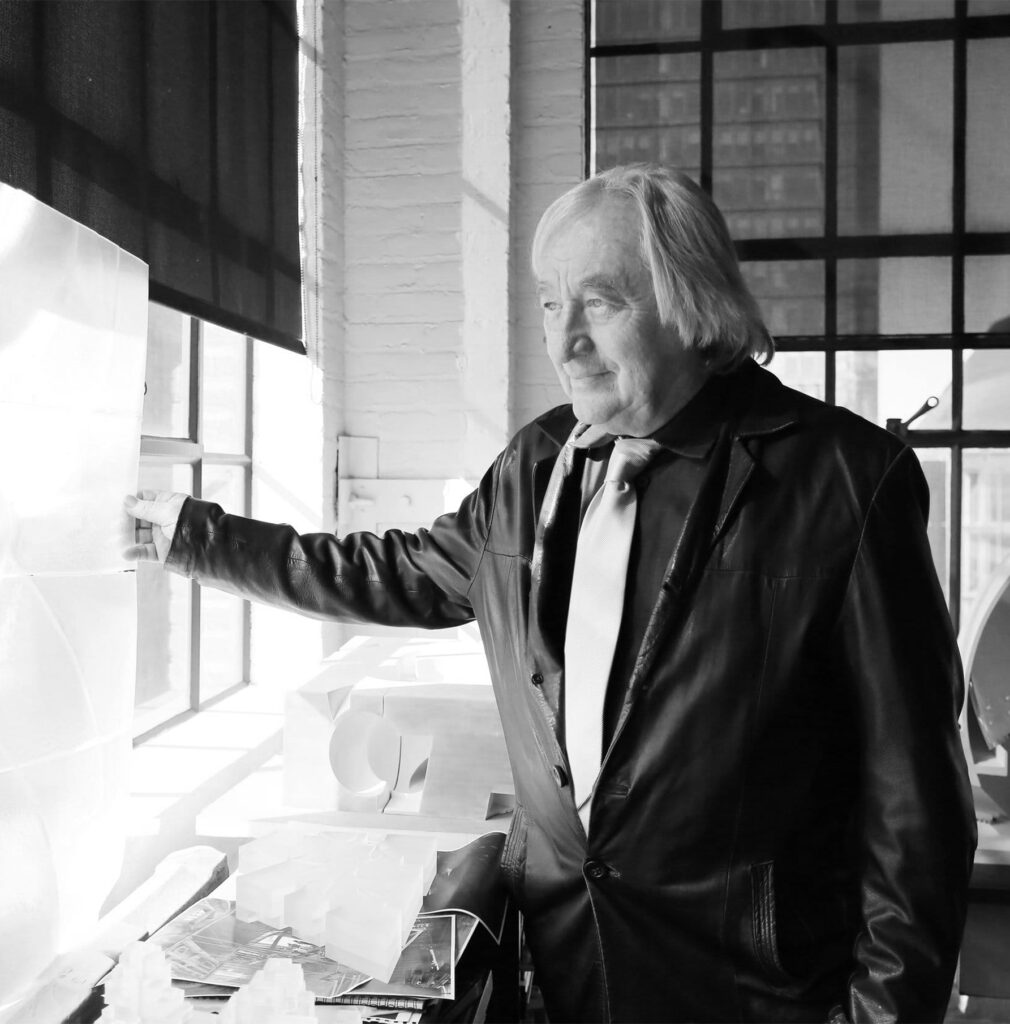
Steven Holl (born 1947) is a prominent American architect and watercolorist known for his phenomenological approach to design, which prioritizes human sensory experience, light, and the specific qualities of a site. After graduating from the University of Washington and continuing his studies in Rome and London, Holl established Steven Holl Architects in New York City in 1977. His practice is distinguished by a refusal to adhere to a signature style; instead, he begins every project with a small watercolor painting to explore the "concept" or "idea" of the building. This process focuses on the play of natural light, the intersection of volumes, and the tactile nature of materials, leading to structures that are often described as poetic and sculptural.
Holl's body of work is characterized by its technical innovation and its sensitivity to urban and natural contexts. One of his most celebrated projects is the Kiasma Museum of Contemporary Art in Helsinki (1998), which utilizes curved zinc and glass surfaces to capture the unique horizontal light of the Nordic region. Other landmark designs include the Simmons Hall dormitory at MIT, noted for its "porosity" and thousands of small windows, and the Linked Hybrid in Beijing, a complex of eight towers connected by skybridges that functions as a "city within a city." His work often integrates sustainable technologies, such as geothermal heating and green roofs, while maintaining a focus on the interaction between the built environment and the...
Steven Holl (born 1947) is a prominent American architect and watercolorist known for his phenomenological approach to design, which prioritizes human sensory experience, light, and the specific qualities of a site. After graduating from the University of Washington and continuing his studies in Rome and London, Holl established Steven Holl Architects in New York City in 1977. His practice is distinguished by a refusal to adhere to a signature style; instead, he begins every project with a small watercolor painting to explore the "concept" or "idea" of the building. This process focuses on the play of natural light, the intersection of volumes, and the tactile nature of materials, leading to structures that are often described as poetic and sculptural.
Holl's body of work is characterized by its technical innovation and its sensitivity to urban and natural contexts. One of his most celebrated projects is the Kiasma Museum of Contemporary Art in Helsinki (1998), which utilizes curved zinc and glass surfaces to capture the unique horizontal light of the Nordic region. Other landmark designs include the Simmons Hall dormitory at MIT, noted for its "porosity" and thousands of small windows, and the Linked Hybrid in Beijing, a complex of eight towers connected by skybridges that functions as a "city within a city." His work often integrates sustainable technologies, such as geothermal heating and green roofs, while maintaining a focus on the interaction between the built environment and the movement of the sun.
Throughout his career, Holl has received numerous prestigious accolades, including the AIA Gold Medal (2012) and the Praemium Imperiale for Architecture (2014). He is also a long-time educator, serving as a professor at Columbia University’s Graduate School of Architecture, Planning and Preservation. His influence extends through both his physical buildings and his extensive theoretical writings, such as Anchoring and Parallax, which examine the philosophical relationship between architecture and time. Today, Holl remains a central figure in contemporary architecture, with his firm continuing to execute major cultural and educational projects globally.
STEVEN HOLL
Steven Holl (born 1947) is a prominent American architect and watercolorist known for his phenomenological approach to design, which prioritizes human sensory experience, light, and the specific qualities of a site. After graduating from the University of Washington and continuing his studies in Rome and London, Holl...
Steven Holl (born 1947) is a prominent American architect and watercolorist known for his phenomenological approach to design, which prioritizes human sensory experience, light, and the specific qualities of a site. After graduating from the University of Washington and continuing his studies in Rome and London, Holl established Steven Holl Architects in New York City in 1977. His practice is distinguished by a refusal to adhere to a signature style; instead, he begins every project with a small watercolor painting to explore the "concept" or "idea" of the building. This process focuses on the play of natural light, the intersection of volumes, and the tactile nature of materials, leading to structures that are often described as poetic and sculptural.
Holl's body of work is characterized by its technical innovation and its sensitivity to urban and natural contexts. One of his most celebrated projects is the Kiasma Museum of Contemporary Art in Helsinki (1998), which utilizes curved zinc and glass surfaces to capture the unique horizontal light of the Nordic region. Other landmark designs include the Simmons Hall dormitory at MIT, noted for its "porosity" and thousands of small windows, and the Linked Hybrid in Beijing, a complex of eight towers connected by skybridges that functions as a "city within a city." His work often integrates sustainable technologies, such as geothermal heating and green roofs, while maintaining a focus on the interaction between the built environment and the movement of the sun.
Throughout his career, Holl has received numerous prestigious accolades, including the AIA Gold Medal (2012) and the Praemium Imperiale for Architecture (2014). He is also a long-time educator, serving as a professor at Columbia University’s Graduate School of Architecture, Planning and Preservation. His influence extends through both his physical buildings and his extensive theoretical writings, such as Anchoring and Parallax, which examine the philosophical relationship between architecture and time. Today, Holl remains a central figure in contemporary architecture, with his firm continuing to execute major cultural and educational projects globally.
STEVEN HOLL
Steven Holl (born 1947) is a prominent American architect and watercolorist known for his phenomenological approach to design, which prioritizes human sensory experience, light, and the specific qualities of a site. After graduating from the University of Washington and continuing his studies in Rome and London, Holl established Steven Holl Architects in New York City in 1977. His practice is distinguished by a refusal to adhere to a signature style; instead, he begins every project with a small watercolor painting to explore the “concept” or “idea” of the building. This process focuses on the play of natural light, the intersection of volumes, and the tactile nature of materials, leading to structures that are often described as poetic and sculptural.
Holl’s body of work is characterized by its technical innovation and its sensitivity to urban and natural contexts. One of his most celebrated projects is the Kiasma Museum of Contemporary Art in Helsinki (1998), which utilizes curved zinc and glass surfaces to capture the unique horizontal light of the Nordic region. Other landmark designs include the Simmons Hall dormitory at MIT, noted for its “porosity” and thousands of small windows, and the Linked Hybrid in Beijing, a complex of eight towers connected by skybridges that functions as a “city within a city.” His work often integrates sustainable technologies, such as geothermal heating and green roofs, while maintaining a focus on the interaction between the built environment and the movement of the sun.
Throughout his career, Holl has received numerous prestigious accolades, including the AIA Gold Medal (2012) and the Praemium Imperiale for Architecture (2014). He is also a long-time educator, serving as a professor at Columbia University’s Graduate School of Architecture, Planning and Preservation. His influence extends through both his physical buildings and his extensive theoretical writings, such as Anchoring and Parallax, which examine the philosophical relationship between architecture and time. Today, Holl remains a central figure in contemporary architecture, with his firm continuing to execute major cultural and educational projects globally.
ARTWORK
ARTWORK
ARTWORK
